

Doctors and nurses probably use these words a lot if you’re taking care of an elderly parent or trying to stay healthy after getting a diagnosis. Understanding what’s the difference between ADLs vs IADLs can really affect how you plan for care, even though they sound clinical. It’s one of those differences that doesn’t seem like a big deal at first.
The short answer is: ADLs, or activities of daily living, are simple chores that people do to take care of themselves, such as bathing and eating. Instrumental Activities of Daily Living (IADLs) are harder tasks, such as cooking or managing money. Both are important, but they show different levels of independence and need different kinds of help.
What Are ADLs?
ADLs, or Activities of Daily Living, are the six basic self-care tasks a person needs to survive: bathing, dressing, eating, toileting, transferring, and continence. Health professionals still use this list, created by physician Sidney Katz in 1963, to measure physical independence.
If you’re asking what does ADLs mean in medical terms, the short version is this: it’s the checklist doctors, nurses, and care teams use to see whether a person can physically take care of their own body without help. Here’s what each item covers:
- Bathing. Washing yourself, including getting in and out of the tub or shower safely.
- Dressing. Picking out and putting on clothes without assistance.
- Eating. Feeding yourself once food is in front of you, including using utensils.
- Toileting. Getting to and from the bathroom, and cleaning up afterward.
- Transferring. Moving between a bed, a chair, and a standing position.
- Continence. Controlling bladder and bowel function.
A struggle with even one of these is worth paying attention to. Loss of ADL function is one of the clearest signs that someone needs a home health aide, an occupational therapist, or a caregiver on a regular basis, and it’s often the first thing a doctor asks about after a fall, a stroke, or a new diagnosis.
What Are IADLs?
IADLs, or Instrumental Activities of Daily Living, are the eight more complex skills people need to live independently: using the phone, shopping, cooking, housekeeping, laundry, transportation, managing medication, and handling finances. Psychologist M. Powell Lawton and his colleague Elaine Brody created this scale in 1969 to measure independent living skills.
Where ADLs are about the body, IADLs are about the mind and the outside world. They ask a bigger question: can this person actually run their own life, not just care for their own body? The eight areas usually include:
- Using the telephone. Looking up a number and making a call without help.
- Shopping. Getting to a store and picking out what’s needed.
- Meal preparation. Planning, cooking, and serving a proper meal.
- Housekeeping. Keeping a home reasonably clean and organized.
- Laundry. Washing and putting away clothes.
- Transportation. Driving or arranging a ride to get where you need to go.
- Managing medication. Taking the right dose at the right time, without reminders.
- Handling finances. Paying bills, budgeting, and avoiding scams.
Comparing iadls vs adls side by side, you’ll notice IADLs lean on memory, judgment, and planning far more than ADLs do. That’s exactly why they tend to slip first, which we’ll cover in a moment.
ADLs vs IADLs: The Core Differences
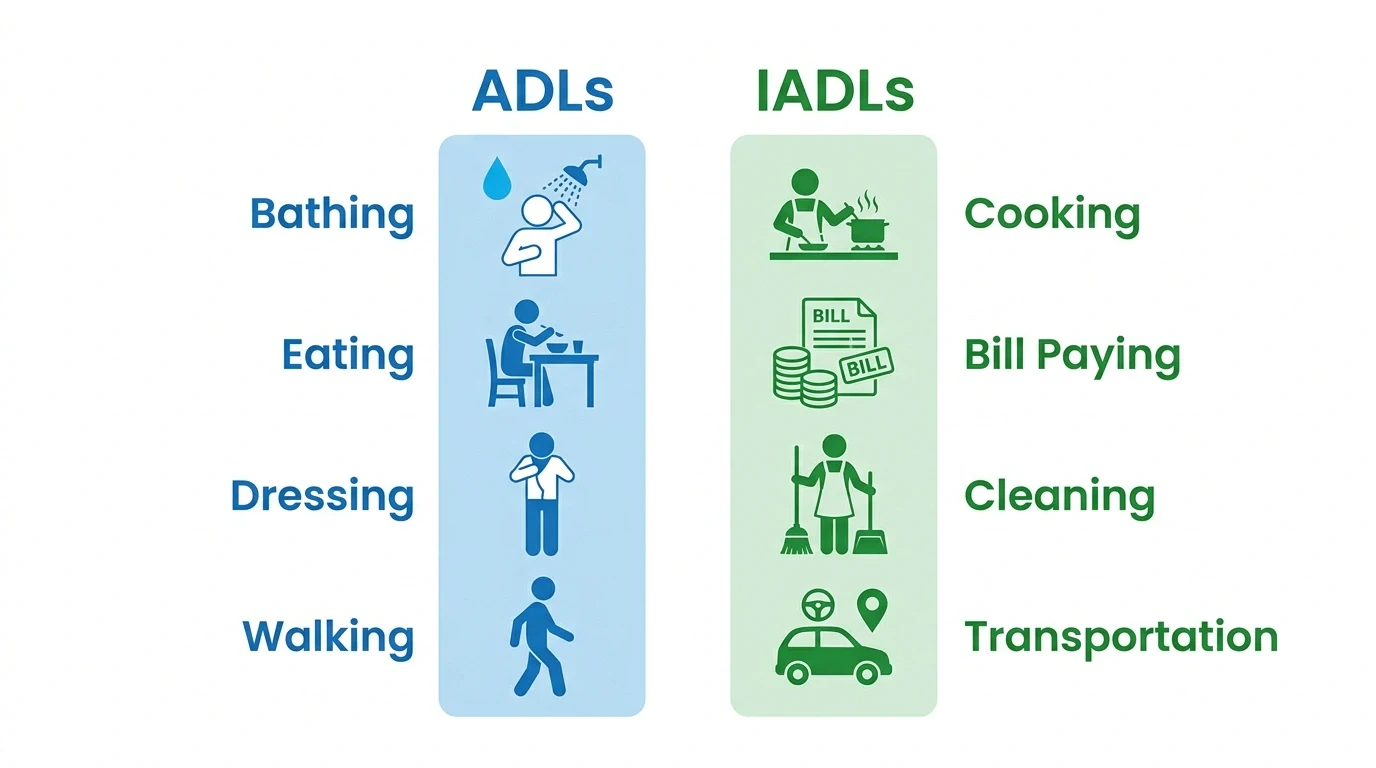
The fastest way to see what’s the difference between ADLs vs IADLs is to line them up next to each other.
| ADLs | IADLs | |
|---|---|---|
| Stands for | Activities of Daily Living | Instrumental Activities of Daily Living |
| Focus | Basic physical self-care | Independent living and household management |
| Skill type | Physical, mostly automatic | Mental, requires planning and judgment |
| Examples | Bathing, dressing, eating, toileting | Cooking, budgeting, driving, managing medication |
| Assessment tool | Katz Index | Lawton IADL Scale |
| Who’s affected | Anyone with a physical limitation, injury, or advanced cognitive decline | Anyone with early cognitive decline, vision loss, or mobility limits |
Assessing ADLs versus IADLs together gives a care team, or a family, a full picture rather than half of one. A person can fail every ADL test and still balance a checkbook, though that’s rare. It’s far more common to see someone manage their own bathing and dressing just fine while their finances or medication schedule quietly falls apart in the background.
Why IADLs Matter More Than Most People Realize
IADLs matter because they serve as early warning signals for cognitive decline, physical illness, and home safety hazards. Spotting changes in these high-level tasks allows families to step in with support before a crisis, such as a missed medication or a serious fall, occurs.
When a loved one struggles with IADLs, the signs are subtle:
-
Unpaid Bills: Stacks of unopened mail or past-due notices signal trouble with executive function.
-
Weight Loss: An empty refrigerator or spoiled food indicates difficulty with shopping or cooking.
-
Medication Errors: Missed pills or incorrect dosages point to memory problems.
-
Isolation: Giving up driving often leads to missed doctor appointments and social withdrawal.
Addressing IADL decline early preserves independence. Simple fixes—like setting up automated bill pay, arranging grocery delivery, or hiring companion care—keep seniors safe in their own homes longer.
Which Comes First: ADL or IADL Decline?
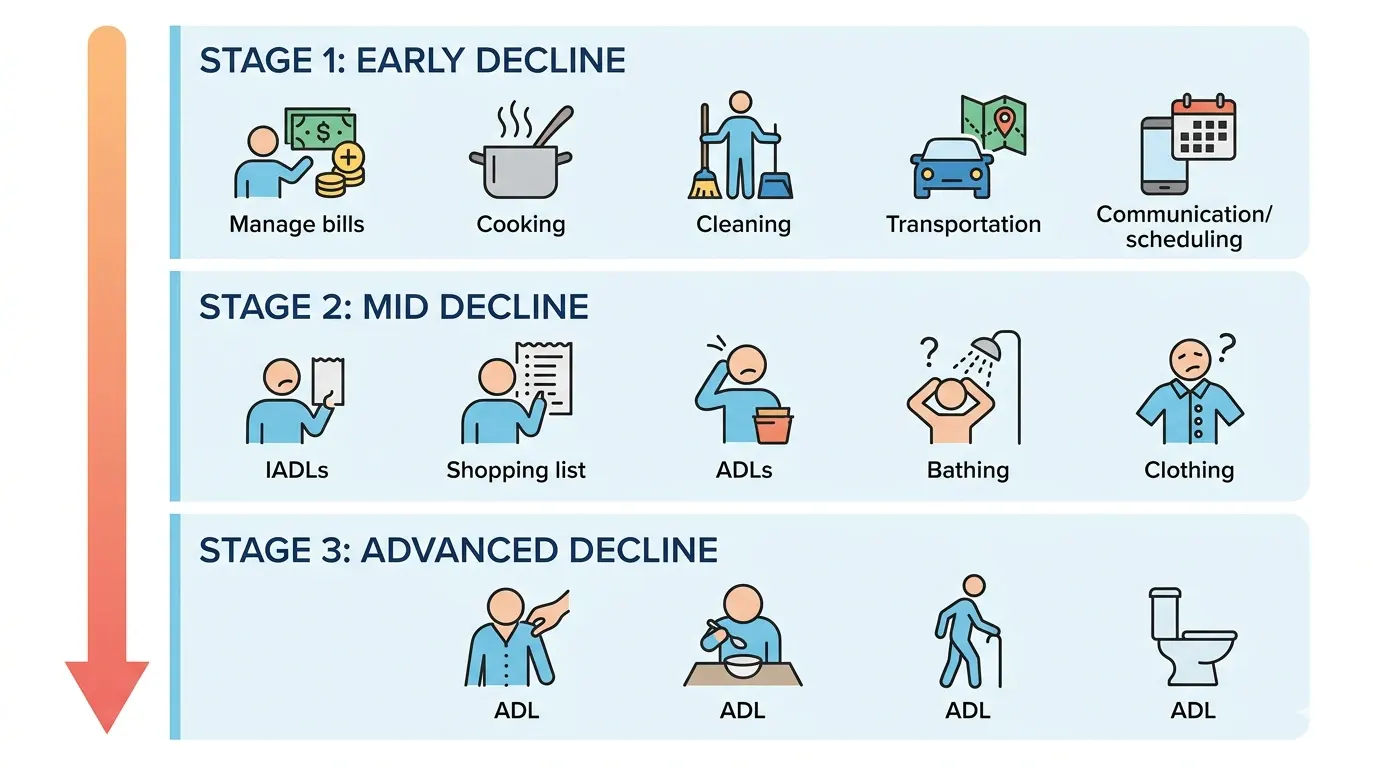
A person generally loses the ability to perform iadls before adls because IADLs require complex brain function, memory, and multi-step planning. As aging, dementia, or chronic conditions progress, high-level organizational skills deteriorate long before physical motor functions like eating or sitting up fail.
Consider how brain health impacts daily performance:
-
Early Phase (IADL Decline): Balancing a checkbook or managing five prescriptions requires clear memory, calculation, and focus. If mild cognitive impairment sets in, these complex activities show strain first.
-
Advanced Phase (ADL Decline): Physical tasks like lifting a fork or washing hands rely on deeply ingrained muscle memory. These skills remain intact until physical mobility declines or cognitive impairment becomes severe.
Recognizing that a person generally loses the ability to perform iadls before adls allows families to plan ahead. When family members notice subtle shifts in meal prep or housekeeping, they can build a care plan before basic physical hygiene becomes a struggle.
Tools for Assessing ADLs and IADLs
Healthcare professionals evaluate functional abilities using standardized assessment tools like the Katz Index of Independence and the Lawton-Brody Scale. These scoring systems help medical teams, insurance providers, and home care agencies pinpoint exact support needs.
The Katz ADL scale measures functional independence across six basic areas: bathing, dressing, toileting, transferring, continence, and feeding.
-
Scoring: Clients receive 1 point for independence and 0 points for dependence in each category.
-
Results: A score of 6 indicates full function, while a score of 2 or lower signals severe functional impairment requiring constant care.
What to Do When ADLs or IADLs Start to Slip
When someone starts struggling with what’s the difference between ADLs vs IADLs in real life, practical support matters more than perfect medical terminology.
For IADL struggles:
- Automated medication reminders or pill dispensers
- Grocery delivery or meal prep services
- Bill payment assistance or financial power of attorney
- Weekly housekeeping support
For ADL struggles:
- Shower grab bars and non-slip mats
- Adaptive utensils for eating
- Part- or full-time home health aide for bathing and dressing
If in-home support isn’t enough, skilled nursing facilities provide 24-hour care for complex medical needs and full ADL assistance.
If you’re based in Colorado and looking for local support, Castle Pines Home Care offers personalized home care services in Denver and surrounding areas. Their team helps families find the right level of assistance, whether someone needs light IADL support or more hands-on daily care.
Frequently Asked Questions
What is IADL in medical terms?
IADL stands for “Instrumental Activities of Daily Living.” It means doing hard things that need thinking abilities, like taking care of money, cooking, and managing prescriptions. Healthcare professionals utilize IADL tests to find out how well someone can live on their own.
What does ADLs mean in medical terms?
ADL stands for Activities of Daily Living. These are basic physical self-care tasks, including bathing, dressing, eating, toileting, transferring, and continence. They form the foundation of functional independence.
Which is an instrumental activity of daily living?
Managing finances, preparing meals, shopping, driving, and taking medications correctly are all IADLs. These tasks require judgment, memory, and planning, unlike basic ADLs which are primarily physical.
Can someone need help with IADLs but not ADLs?
Yes, and it’s actually common. People in early-stage dementia or with mild cognitive impairment often struggle with IADLs while still managing basic self-care tasks independently.
How often should ADLs and IADLs be assessed?
There’s no fixed schedule. Most providers assess ADL and IADL function at annual wellness visits, after hospitalizations, or whenever there’s a noticeable change in a person’s behavior or independence. Routine cognitive testing for patients over 65 can be billed under Medicare during annual wellness visits.