
Yes, but it depends. Original Medicare does not cover routine eye exams, eyeglasses and contact lenses. It does include eye treatment for disorders such as glaucoma, diabetic retinopathy and macular degeneration. That divide catches a lot of families off guard, particularly when a parent’s vision begins to change and no one knows who’s supposed to pay for what.
If you’re wondering does Medicare cover eye care for seniors before a checkup or a surgical date gets locked in, you’re at the perfect place. We’ll explain exactly what Part A, Part B and Medicare Advantage include, what you’ll have to pay out-of-pocket, and where to get free or low-cost support when the bill isn’t addressed to Medicare.
What Original Medicare Covers for Eye Care
Does Original Medicare cover routine vision care?
Original Medicare does not cover routine eye exams, glasses, or contact lenses for healthy eyes. Part B only pays for diagnostic tests and treatments when a licensed eye doctor diagnoses a medical disease, an acute injury, or a progressive age-related eye condition.
Many people expect Part B to act like private vision insurance, but it operates as strictly medical insurance. If you visit an optometrist just to update a prescription for reading glasses, you pay the entire bill out of pocket. The doctor performs a refraction test to measure your lens strength, and Medicare excludes this specific test by law.
However, the story changes when an eye issue links to a broader health problem. Part B steps in once care transitions from general maintenance to medical treatment. For covered medical visits, you pay your 20% coinsurance after meeting the annual Part B deductible ($283 in 2026).
Cost Type 2026 Standard Amount
Part B Monthly Premium $202.90
Part B Annual Deductible $283.00
Medical Coinsurance 20% of Medicare-approved amount
Routine Refraction Exam 100% Patient Responsibility
Part A handles eye health only if you need an emergency inpatient hospital stay for severe facial trauma or major eye surgery. Outpatient procedures, clinic visits, and office checkups always go through Part B.
What Original Medicare Does NOT Cover
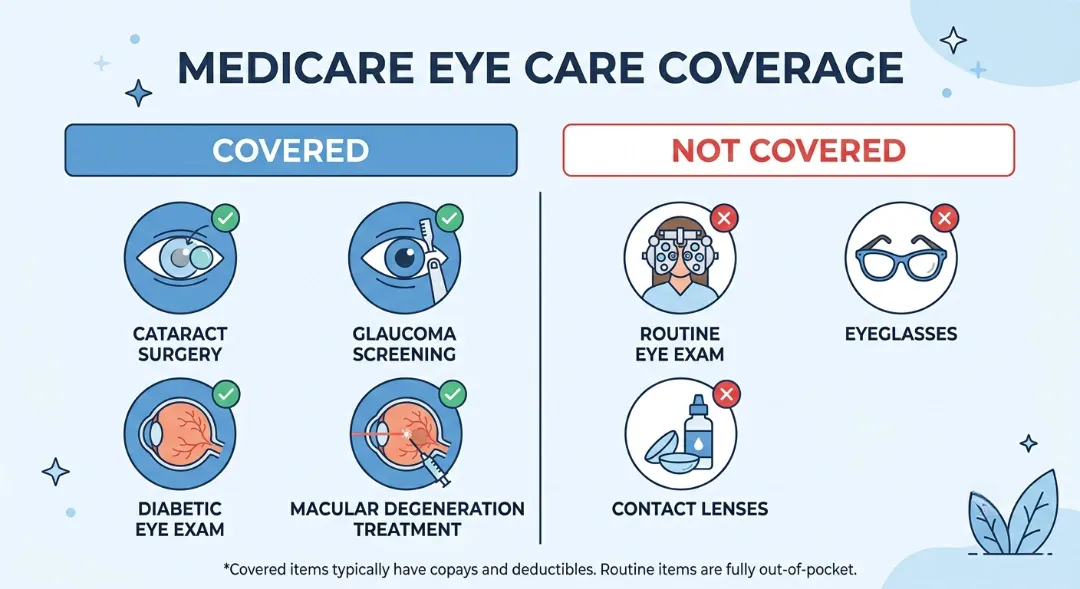
Knowing what falls outside coverage helps you avoid unexpected bills. Original Medicare leaves noticeable gaps in daily vision care.
- Routine Vision Screening: Standard yearly checkups to check visual acuity aren’t covered.
- Eyeglass Frames and Lenses: Part B won’t buy everyday frames, progressive lenses, or anti-glare coatings.
- Contact Lenses and Fittings: Routine contacts and fitting fees remain 100% your responsibility.
- Elective Refractive Surgery: Procedures like LASIK or PRK are never covered because Medicare views them as elective cosmetic options.
Getting glasses is like a tune-up for the motor of your car. Original Medicare views tune-ups as routine maintenance. It only works when something breaks down. The fact that about 83% of older persons wear corrective lenses means that most people will have to find another way to pay for their eye care because of these exclusions.
If you ask your doctor for an eye refraction during a covered diabetic exam, the clinic charges a separate fee for the refraction. You may see a separate charge for that prescription measurement that can range from $40 to $90. Always ask the front desk staff before you come in for your appointment which parts of your visit are diagnostic and which parts are routine.
Medical Eye Conditions Covered Under Medicare
When age-related vision loss or serious medical issues threaten your eyesight, Medicare Part B provides vital safety nets. Knowing which diagnostic codes trigger coverage ensures you get every benefit you’re owed.
Medical Conditions Covered by Medicare Part B
| Medical Eye Condition | Covered Service or Treatment | Eligibility Requirements | Patient Cost Share (2026) |
| Cataracts | Surgical removal, Intraocular Lens (IOL) implant, plus 1 pair of post-surgery glasses | Medically necessary visual impairment | 20% after $283 Part B deductible |
| Diabetic Retinopathy | Annual dilated eye exam by a state-licensed eye doctor | Formally diagnosed with Diabetes Mellitus | 20% after $283 Part B deductible |
| Glaucoma | Annual screening to test optic nerve health and fluid pressure | High risk: Diabetes, family history, or qualifying age/ethnicity | 20% after $283 Part B deductible |
| Macular Degeneration (AMD) | Diagnostic imaging and Anti-VEGF medication injections | Diagnosed with wet or progressive dry AMD | 20% after $283 Part B deductible |
Cataract Surgery and Post-Surgery Eyewear
Does Medicare cover cataract surgery for older adults? Yes, Part B covers cataract procedures when clouding in your natural lens impairs your ability to handle everyday tasks like reading or driving safely.
Medicare pays for traditional wave techniques or modern laser methods to remove the cloudy lens. It also pays for a standard monoprice Intraocular Lens (IOL) inserted during surgery. If you pick a premium multifocal lens to reduce your reliance on reading glasses, you must pay the price difference out of pocket.
Part B makes one famous exception regarding glasses. Does Medicare cover glasses after you’ve had cataracts removed? Yes! Medicare covers one pair of basic eyeglasses with standard frames or one set of contact lenses following each cataract surgery with an IOL implant.
You must purchase your corrective lenses from an optical supplier enrolled in Medicare. If you select designer frames, scratch-resistant coatings, or progressive lenses, Part B pays only the basic frame amount, leaving you with the upgrade fees.
Diabetic Retinopathy Exams
Diabetic retinopathy damages delicate blood vessels across the retina, making early detection critical for protecting clear vision. If you have diabetes, Part B pays for one dilated eye exam every 12 months.
An optometrist or ophthalmologist legally certified in your state must perform the examination. You pay 20% of the Medicare-approved charge after satisfying your annual Part B deductible. Catching vascular leaks early helps prevent permanent central vision loss.
Glaucoma Screenings for High-Risk Individuals
Glaucoma is often called the silent thief of sight because fluid pressure builds inside the eye without causing early pain. Over time, this pressure harms the optic nerve and damages peripheral vision.
Part B covers a full glaucoma screening once every 12 months if you meet high-risk criteria. You qualify as high risk if you meet at least one of these conditions:
- You have a medical diagnosis of diabetes mellitus.
- You have a documented family history of glaucoma.
- You are African American and age 50 or older.
- You are Hispanic and age 65 or older.
The screening includes dilated eye checks, intraocular pressure measurements, and direct optic nerve assessments.
Age-Related Macular Degeneration (AMD) Treatments
Age-related macular degeneration harms the center of your retina, creating blurry spots or blank areas right in the middle of your visual field. It makes recognizing faces or reading fine print challenging.
Does Medicare cover eye exams and advanced treatments for AMD? Part B covers diagnostic optical coherence tomography (OCT) scans and special eye injections. Anti-VEGF medications injected into the eye help stop abnormal blood vessel growth in wet AMD.
Because doctors give these injections in outpatient clinic settings, Part B covers the medication and procedure. You pay your standard 20% coinsurance after meeting the $283 Part B deductible.
How Medicare Advantage and Medigap Handle Vision
Does Medicare Advantage cover routine eye exams and glasses?
Medicare Advantage (Part C) plans cover routine eye exams, glasses, and contact lenses through added vision benefits. Most plans provide $0 routine exam copays and annual eyewear allowances ranging between $100 and $300 to help lower your overall costs.
Medicare Advantage plans replace Original Medicare by bundling Part A, Part B, and usually Part D prescription drug coverage into one plan managed by private insurance companies. Over 98% of Part C plans offer extra Medicare Advantage vision benefits to attract shoppers
These plans help cover expenses that Original Medicare ignores. When shopping for Medicare vision coverage 2026 options, keep a close watch on these features:
- Annual Eyewear Allowances: Plans grant a set dollar amount (usually $100 to $300 per year) toward frames, prescription lenses, or contact lenses.
- Network Limits: You must use preferred in-network doctors (like VSP or EyeMed networks) to get full benefits. Going out of network increases your out-of-pocket spend.
- Flexible Spending Cards: Many 2026 plans issue prepaid flex cards loaded with quarterly or annual allowances for vision, dental, and hearing expenses.
What about Medigap (Medicare Supplement) plans?
Medigap policies are designed to cover the deductibles, copays and coinsurance that Original Medicare leaves open. They do not generate new benefit categories.
If your Part B covers your cataract surgery, Medigap pays your 20% coinsurance. But if Original Medicare doesn’t pay for a basic refraction exam or a new pair of eyeglasses, Medigap won’t either. Some Medigap companies provide separate vision riders you can purchase for an additional monthly premium. But regular Medigap plans do not include vision benefits.
Out-of-Pocket Costs for Eye Care in 2026
How much does eye care cost without coverage?
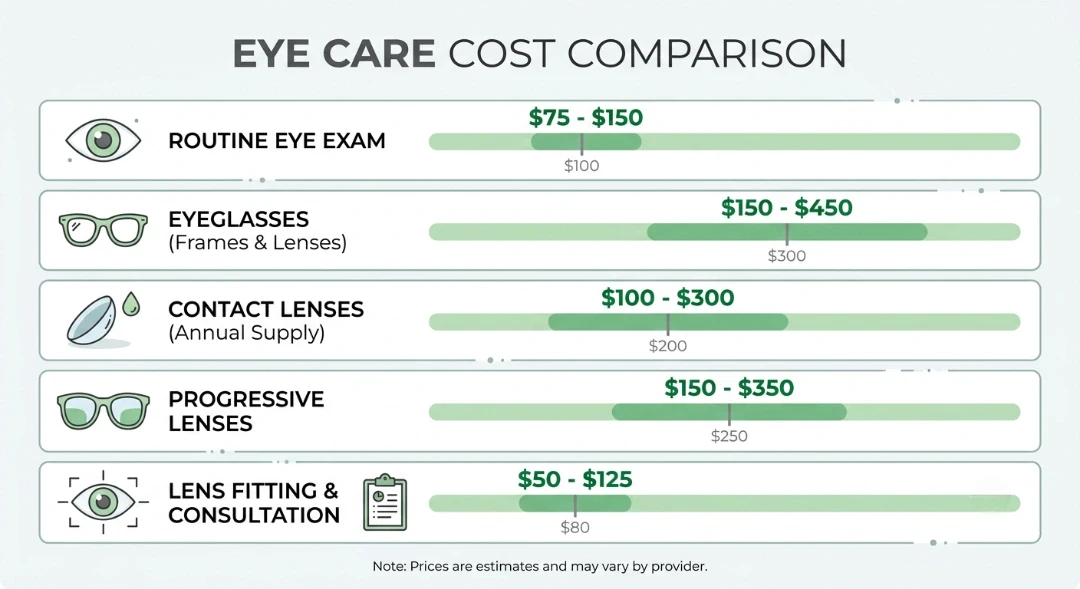
Without insurance coverage, seniors pay $75 to $250 out of pocket for a basic routine eye exam. A complete pair of eyeglasses averages $200 to $600, while a yearly supply of contact lenses typically costs between $150 and $500.
Managing age-related vision changes gets expensive quickly if you pay full retail price. Every extra feature adds to your final total at the optical register.
| Vision Service or Item | Average Out-of-Pocket Cost | Frequency Needed |
| Comprehensive Eye Exam | $75 – $250 | Every 1 – 2 years |
| Refraction Measurement | $40 – $90 | Per vision check |
| Standard Frames & Lenses | $200 – $600 | Every 1 – 2 years |
| Progressive Lens Upgrade | $150 – $350 (extra) | Optional addition |
| Annual Contact Lenses | $150 – $500 | Yearly supply |
| Contact Lens Fitting Fee | $50 – $150 | Yearly requirement |
These numbers add up fast if you need a new prescription every year, which is common as age-related vision loss progresses. That’s usually the moment people start comparing Medicare Advantage vision benefits against a standalone vision insurance policy, since the math often favors whichever option matches how often you actually need new glasses.
4 Ways Seniors Can Get Free or Low-Cost Vision Care
If Original Medicare leaves you facing high costs for eyeglasses or routine checks, several national programs offer relief. You don’t have to sacrifice vision health due to tight household budgets.
1. EyeCare America
Sponsored by the American Academy of Ophthalmology, EyeCare America offers medical eye exams at no out-of-pocket cost. Volunteer eye specialists across the country donate their time to care for older adults.
To qualify for the Senior Program, you must be 65 or older, a U.S. citizen or legal resident, and haven’t seen an eye doctor in three years or more. The program focuses on diagnosing medical issues like glaucoma, AMD, and cataracts.
2. VSP Eyes of Hope
VSP Vision runs the Eyes of Hope initiative, providing free gift certificates for eye exams and basic glasses. They partner with local community organizations to support low-income seniors.
Qualifying individuals receive vouchers accepted by thousands of participating VSP doctors nationwide. This program fills a major gap by covering routine prescriptions and frames that Medicare skips.
3. Local Lions Clubs International
Lions Club chapters focus on protecting community sight. Local clubs operate eyeglass recycling centers, organize free community screening days, and sponsor prescription glasses for low-income residents.
Reach out to your municipal or county Lions Club to ask about financial aid for eyeglasses. Many chapters work with local optical shops to cover basic frame costs.
4. Optometry School Clinics
University optometry schools operate public outpatient clinics to train upcoming optometrists. Fully licensed faculty professors closely supervise every exam step.
These clinics offer comprehensive eye exams, refraction checks, and eyewear packages at discounts of 40% to 70% off retail prices. Appointments take a little longer, but the savings make them a fantastic choice for senior eye care.
Recognizing Vision Changes and Protecting Eye Health
As we age, keeping an eye on sight changes helps prevent permanent damage. Knowing what’s normal and what requires immediate care protects your independence.
Normal Age Changes vs. Warning Signs
Slowly needing brighter light to read fine print is a normal part of getting older. However, sudden shifts signal an emergency. You should contact an eye specialist right away if you notice any of these red flags:
- Sudden vision changes: Waking up with dark curtains, dark spots, or shadowy areas across your visual field.
- Blurry vision: Experiencing rapid haziness that makes reading or recognizing faces difficult.
- Flashes and Floaters: Seeing sudden bursts of light or a sudden shower of new floating specks.
- Eye Pain or Redness: Sharp eye pain accompanied by severe nausea or cloudy vision.
When you report acute symptoms like sudden vision changes or pain to a doctor, Part B steps in to cover the emergency diagnostic check. Do not wait for a routine eye exam date if you notice sudden drops in sight.
How In-Home Support Helps Seniors Managing Vision Loss
Living with age-related vision loss creates daily challenges around the house. Simple daily tasks like reading medication labels, chopping vegetables, or walking down hallways become safety hazards.
Having non-clinical support at home allows older adults to stay safe and independent while adjusting to sight changes. Care companions assist with household tasks that grow difficult when vision fades:
- Organizing living spaces to eliminate trip hazards and loose rugs.
- Assisting with meal preparation and safely setting stove controls.
- Providing transportation to medical appointments and optical visits.
- Reading mail, bills, and prescription bottle instructions clearly.
- Offering gentle physical guidance during walks inside or outside.
If your family needs compassionate assistance to help an aging relative stay safe at home, exploring professional home care services in Denver provides peace of mind. The trained team at Castle Pines Home Care supports older adults with daily living needs, ensuring they enjoy comfort, safety, and dignified care in familiar surroundings.
Final Thoughts on Medicare Vision Coverage
Once you understand the rules, it’s not difficult to game eyesight benefits. Never forget the golden rule: Original Medicare covers medical eye illnesses including cataracts, glaucoma, and macular degeneration, but you’re on your own for routine examinations and glasses.
By reviewing your coverage each fall, you may answer does medicare cover eye treatment for seniors based on your own health needs. If you need help paying for yearly glasses, consider Medicare Advantage or standalone vision policies. Need advice on how to care for an elderly family member in the home? Contact us today and see how our compassionate care team can help.
Frequently Asked Questions
Does Medicare cover eye exams at retail optical chains?
Part B covers medical eye visits at retail chains if the practicing doctor accepts Medicare assignment. However, Original Medicare will not pay for routine refraction exams for glasses at optical stores. You must pay out of pocket or use a Medicare Advantage vision plan.
How can I get an eye exam covered if I don’t have diabetes or glaucoma?
If you experience medical symptoms like eye pain, dry eyes, blurry vision, or red eye infections, Part B covers the diagnostic examination. The appointment must focus on evaluating a medical complaint rather than measuring for new glasses.
Does Medicare cover LASIK or corrective vision surgery?
No, Original Medicare considers LASIK and PRK elective refractive procedures. Because these surgeries correct basic vision without treating an underlying eye disease, Medicare will not pay for them. Patients pay all costs out of pocket.
Can I buy standalone vision insurance if I have Original Medicare?
Yes, you can purchase private standalone vision insurance through providers like VSP, EyeMed, or Humana while keeping Original Medicare. These individual plans cost around $15 to $25 per month and help cover annual exams and eyewear allowances.