Opening a jar, lifting a grocery bag, pushing up from a chair: your arms do more work than you’d guess. Strength there fades with age, but it comes back with steady practice. If you’re searching for how to build upper body strength for seniors, here’s the short answer. Do two or three light sessions a week with resistance bands, small dumbbells, or your own body weight, and add effort slowly.
This guide covers safe exercises, a weekly plan, equipment, and food that helps muscle grow. You’ll also learn which warning signs mean “stop.” Start small, and your arms will notice within a few weeks.
Why Upper Body Strength Matters for Seniors
Strong arms keep everyday tasks easy and keep you independent. Adults slowly lose muscle and grip strength from midlife on, and the loss speeds up later. Severe muscle loss has a name: sarcopenia.
Your shoulders and back matter just as much. Think of them as the roof beams of a house. Let them weaken, and everything below starts to sag, which shows up as stooped posture and a harder time catching yourself in a stumble.
Strength training also supports bone density, mood, and sleep. Both the CDC and the World Health Organization advise older adults to do muscle-strengthening activity at least two days a week.
Essential Safety Rules Before You Start

Talk to your doctor first if you have heart disease, high blood pressure, osteoporosis, a recent surgery, or shoulder pain. Then follow these rules:
- Warm up for five minutes. March in place and roll your shoulders.
- Sit when balance feels shaky. Use a sturdy chair without wheels, placed against a wall.
- Breathe out on the effort. Never hold your breath while you push or pull.
- Know the difference in pain. Mild muscle burn is fine. Sharp joint pain means stop.
- Pick a light weight. You should finish 10 to 12 repetitions with smooth form.
- Keep someone nearby for your first few sessions.
The Best Upper Body Exercises for Seniors

This section covers the core exercises for an upper body workout for seniors. Each one targets a different muscle group, so together they build balanced strength rather than overworking one area.
Shoulder Exercises for Seniors
Lateral raises build shoulder mobility and strength without much strain. Stand or sit with a light weight in each hand, arms at your sides. Raise your arms out to the sides until they’re level with your shoulders, then lower slowly. Aim for 8 to 10 reps.
Wall angels are gentler and great for those with limited shoulder mobility. Stand with your back against a wall, arms bent at 90 degrees. Slide your arms up and down the wall slowly, keeping contact with the surface. This improves upper body mobility over time.
Arm Exercises for Seniors
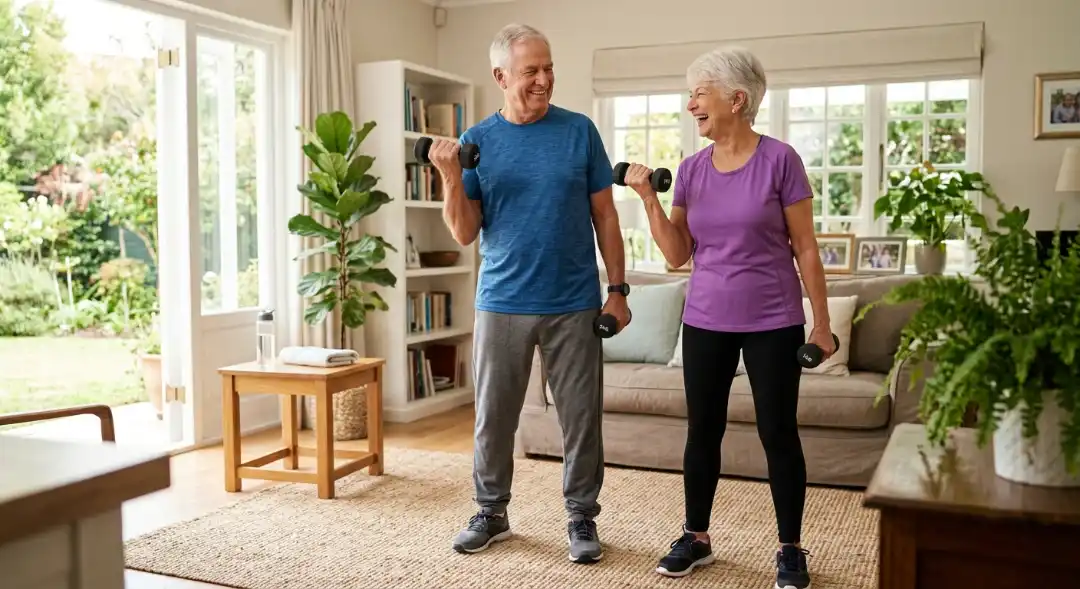
Bicep curls are a classic for a reason. Hold a light dumbbell in each hand, palms facing forward, and curl the weight toward your shoulder. Lower slowly. This is one of the simplest dumbbell exercises for seniors and builds muscle activation in the front of the arm.
Tricep extensions balance out the curls by working the back of the arm. Hold a light weight overhead with both hands, then bend your elbows to lower it behind your head before pushing back up. Keep your elbows close to your ears throughout.
Chest and Pushing Movements
Wall push-ups are one of the safest pushing movement exercises available. Stand an arm’s length from a wall, place your palms flat against it, and lower your chest toward the wall before pushing back. This builds chest and shoulder strength without stressing the wrists or knees.
Seated chest press works well with resistance bands looped behind a sturdy chair. Push your arms forward until they’re extended, then return slowly. This is a low-impact way to build pushing strength and muscle endurance.
Core Support for Upper Body Work
A strong core supports every upper body movement you make. Seated torso twists, done slowly with hands on opposite shoulders, activate the muscles that stabilise your spine during lifting and pushing. Skipping the core is a common mistake that limits progress elsewhere.
How Often Should Seniors Train Upper Body?
Seniors should train their upper body two to three non-consecutive days per week, with at least one rest day between sessions. Each session needs one to two sets of 8 to 12 repetitions per exercise. Muscles repair and grow during rest, so recovery days matter as much as workouts.
A simple start is Monday and Thursday. After four weeks of comfortable sessions, add a second set or a third day. On off days, take a walk or try gentle tai chi. Slow and steady wins here, much like the tortoise in the old fable.
Exercise Summary and Safety Matrix
| Exercise | Equipment | Position | Difficulty | Main safety tip |
|---|---|---|---|---|
| Wall push-up | None | Standing | Easy | Keep your back straight |
| Seated overhead press | Light weights | Seated | Moderate | Stop if shoulders pinch |
| Band row | Resistance band | Seated | Easy | Anchor the band firmly |
| Bicep curl | Light weights | Seated | Easy | Avoid swinging |
| Lateral raise | Light weights | Seated | Moderate | Stay at shoulder height |
| Band pull-apart | Resistance band | Seated | Easy | Keep wrists straight |
| Grip squeeze | Soft ball | Seated | Easy | Release if hands cramp |
When you’re learning how to build upper body strength for seniors, start with the “Easy” rows and add the rest over several weeks.
Exercise Summary and Safety Matrix
| Exercise | Target Muscles | Equipment Needed | Primary Daily Benefit | Safety Caution |
| Wall Push-Ups | Chest, Front Shoulders, Triceps | Wall | Pushing open heavy doors | Avoid letting lower back arch |
| Seated Press | Shoulders, Upper Triceps | Light Dumbbells or Water Bottles | Reaching upper shelves | Avoid if sharp shoulder pain occurs |
| Seated Band Rows | Rhomboids, Lats, Rear Shoulders | Resistance Band | Posture support and pull strength | Keep spine still; do not rock torso |
| Bicep Curls | Biceps Brachii, Forearms | Dumbbells or Canned Goods | Carrying items securely | Avoid swinging arms for momentum |
| Wall Angels | Scapular Stabilizers, Upper Back | Wall | Improving posture and reach | Do not force wrists to touch the wall |
| Seated Side Bends | Obliques, Deep Core | Body weight or Light Weight | Turning and bending safely | Avoid bending forward while leaning |
How to Choose the Right Equipment
You do not need an expensive gym setup to build strength effectively.
Body Weight and Household Items
Body weight provides a safe starting resistance level. Walls, sturdy dining chairs, and countertop surfaces work well for modified exercises. Unopened soup cans (roughly 1 pound each) or 16-ounce water bottles (about 1 to 1.5 pounds) make convenient starter weights.
Resistance Bands
Resistance bands are an ideal choice for older adults. Unlike free weights, bands provide constant tension throughout the movement without subjecting joints to harsh gravitational pulls. Choose flat, handles-free bands color-coded for light to medium resistance.
Dumbbell Exercises for Seniors
When transitioning to dumbbells, select vinyl-coated weights between 2 and 5 pounds. Vinyl coatings provide a secure grip for hands affected by arthritis. Always prioritize control over heavier numbers.
Nutrition Tips to Support Muscle Building
Protein is the main nutrient seniors need to support muscle building alongside strength training. Without enough protein, the body struggles to repair and build the muscle fibres broken down during exercise. Older adults often need more protein per pound of body weight than younger adults, not less.
Good sources include eggs, fish, chicken, Greek yogurt, and legumes. Spreading protein intake across meals, rather than eating it all at dinner, helps the body use it more efficiently throughout the day. A boiled egg at breakfast and a piece of fish at lunch adds up faster than people expect.
Hydration plays a role too. Muscles are mostly water, and even mild dehydration can make workouts feel harder and recovery slower. Vitamin D and calcium also support the bones that upper body muscles pull against, so a balanced diet backs up everything the exercises are doing.
Signs of Progress and When to Adjust
Progress with senior strength training often shows up in daily life before it shows up on a scale or in the mirror. Opening a jar without help, carrying two bags of groceries, or getting up from a low chair without pushing off with your hands are all real signs of gains.
If an exercise starts feeling easy after two or three weeks, that’s your cue to add a small amount of weight or an extra rep, not to stop. On the other hand, if you notice joint pain that lingers beyond the workout itself, scale back and check in with a doctor or physical therapist.
Final Thoughts
Building strength later in life isn’t about lifting heavy or training hard every day. It’s about consistency, safe form, and small progress that adds up over weeks and months. Start with light weights, train your upper body two to three times a week, and pair it with enough protein and rest.
If you or a loved one wants extra support putting together a safe routine, or simply needs help around the house while building strength, that’s exactly the kind of support we provide through home care services in Denver. At Castle Pines Home Care, we help seniors stay active, safe, and independent at home. Contact us today to talk about what support could look like for your family.
Frequently Asked Questions
Can seniors really build muscle after 70?
Yes, seniors can build muscle after 70 through consistent resistance training. Studies on older adults doing structured strength programs show measurable muscle gains within 8 to 12 weeks. Age slows the process, but it doesn’t stop it, especially when paired with enough protein and rest.
What’s the safest equipment for beginners?
Resistance bands are generally the safest equipment for beginners starting upper body work. They’re gentle on joints, adjustable in difficulty, and far less likely to cause injury from dropping or improper form compared to free weights. Bands also work well for people with arthritis or limited grip strength.
How long before I see results?
Most people notice small strength improvements within three to four weeks of consistent training. Visible changes in muscle tone tend to take longer, often eight to twelve weeks, depending on diet and consistency. Patience matters more than intensity in this process.
Is it normal to feel sore after these workouts?
Mild soreness one to two days after a new exercise is normal and usually fades on its own. Sharp or lasting pain is not normal and should be checked by a doctor before continuing the same movement.