If you’ve ever worried about leaving a loved one alone at home, you already understand the core idea behind what is protective oversight. It’s that constant, quiet concern what if something happens when no one is watching? That worry is valid. And there’s actually a structured, funded solution built around it.
Protective oversight is a form of non-medical supervision designed to keep individuals safe in their own homes when they can’t fully monitor or protect themselves due to a mental impairment or illness. Think of it as a safety net not a medical procedure, but a human presence that watches, responds, and steps in before something goes wrong. In this guide, we’ll walk through what it means, who qualifies, what the process looks like, and how families can access it.
Understanding the Importance of Protective Supervision
Most people picture home care as help with bathing, cooking, or medication. Protective supervision is different. It focuses on one specific risk: the danger that comes when a person can’t assess their own environment clearly.
For someone with a cognitive impairment, a hot stove isn’t just a stove. An open front door isn’t just a door. These are potential emergencies. Protective supervision keeps a trained eye on situations like these before they turn into injuries, hospital visits, or worse.
According to the National Council on Aging, falls and accidents at home are among the leading causes of injury for older adults and individuals with disabilities.The value of this service goes beyond safety. It gives families peace of mind. It allows individuals to stay in a familiar environment rather than moving into a facility. That matters deeply to most people.
The Concept and Significance of Protective Supervision
Protective supervision is a non-medical service that provides continuous monitoring to individuals who, due to mental illness or cognitive impairment, cannot safely identify hazards or make safe decisions on their own. It is not about controlling someone it’s about being present so harm doesn’t occur.
The service is based on a basic premise: certain individuals need someone with them, not because they can’t move, or eat, but because their judgment is affected in ways that create genuine danger. A person may be wandering around the house, touching a hot stove or misusing household equipment, without knowing they are in risk.
That’s when protective monitoring comes in. A caregiver, termed the provider, often stays with the person, observes the behavior, and steps in when needed. It’s not reactive care. It’s preventative.
This kind of vigilance is also part of managing chronic illnesses. Such monitoring can be particularly important for someone with diabetes, for example, who could otherwise miss timely reminders to take prescriptions or to identify the early warning signals of high or low blood sugar. (Suggest insert here one data point about the link between unsupervised medication management and hospital readmission rates.
What Are the Eligibility Requirements for Protective Supervision?
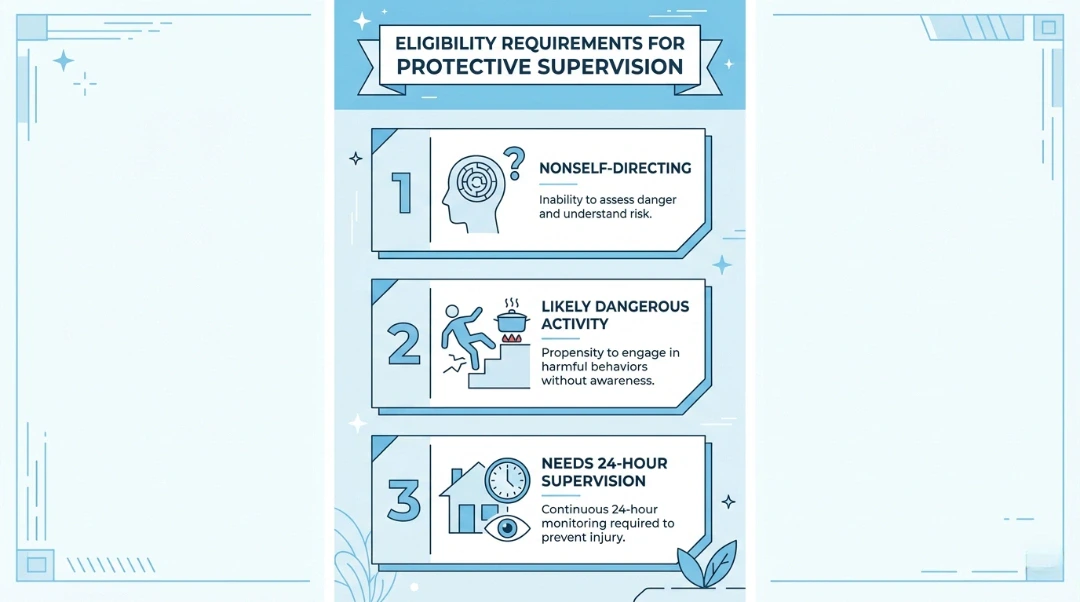
To qualify for protective supervision under the IHSS program in California, an individual must be nonself-directing due to a mental impairment, be likely to engage in dangerous activity, and require 24-hour supervision to remain safely at home. These three criteria must all be present at the time of assessment.
Here’s what each requirement actually means in plain terms:
Nonself-directing means the person cannot assess risk or danger due to their mental state not just that they need reminders, but that they genuinely don’t recognize when something is dangerous. Examples include wandering outdoors, touching hot surfaces, misusing kitchen appliances, or eating non-food items.
Likely to engage in dangerous activity means there’s a documented pattern of unsafe behavior. The person doesn’t have to be injured first. A history of attempting unsafe actions is enough.
24-hour supervision requirement means the dangerous behaviors are frequent and unpredictable enough that someone needs to be present consistently. It doesn’t mean the person is in danger every single minute, but the risk is ongoing and can’t be scheduled around.
For minors, there’s an additional condition: the child must require more supervision than a neurotypical child of the same age, both in time and intensity.
Notable exceptions exist. Protective supervision is not available for routine childcare, anti-social behavior directed at others, or situations where the supervision required is medical in nature.
What Documentation Do I Need for Protective Supervision?
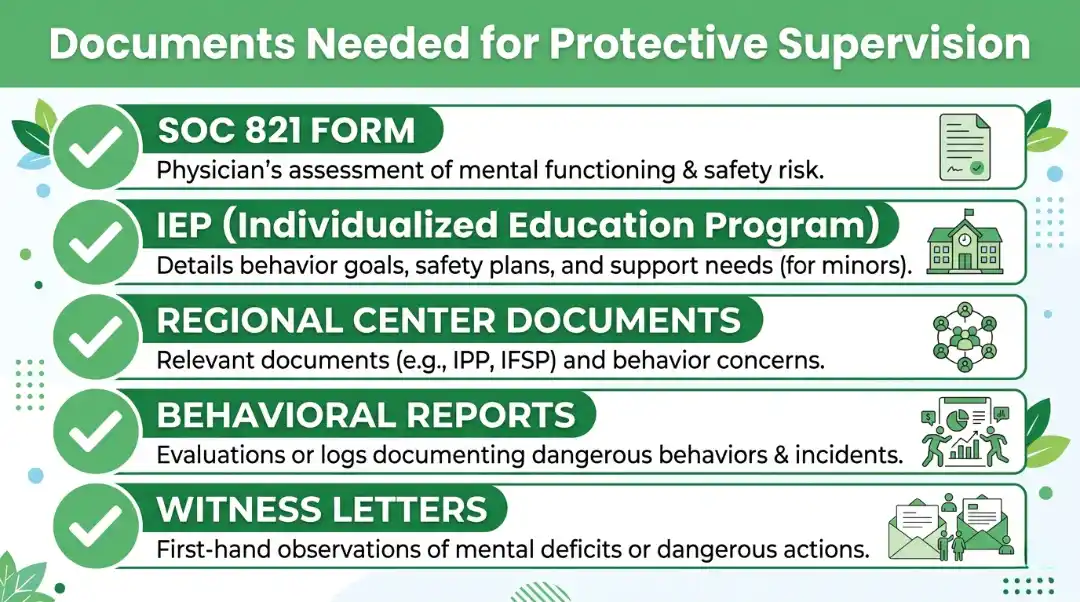
The strongest applications include a completed SOC 821 form from a healthcare provider, relevant school or regional center records, and written statements from people who regularly observe the applicant’s behavior. Documentation makes or breaks most protective supervision cases.
Here’s the core paperwork to gather:
- SOC 821 (Assessment of Need for Protective Supervision) filled out by a healthcare professional who knows the individual well
- IEP (Individualized Education Program) if the applicant is a school-age child
- Regional Center Documents such as an IPP or IFSP, if the individual is a regional center client
- Behavioral evaluations or psychological reports any professional report documenting cognitive deficits, dangerous behaviors, or impaired judgment
- Witness letters from teachers, behavioral aides, therapists, or other caregivers who have observed risky behaviors first-hand
One practical tip: ask the healthcare professional completing the SOC 821 to be as specific as possible. General language like “needs supervision” is far less effective than documented examples of actual incidents, such as “on three separate occasions, the individual attempted to leave the home unassisted at night.”
What Happens at the Assessment for Protective Supervision?
At the assessment, a county social worker visits the applicant’s home to evaluate physical and mental functioning, living conditions, and daily safety risks. This visit forms the basis of the county’s decision to approve or deny protective supervision services.
The social worker will ask questions about the applicant’s daily behaviors, history of dangerous incidents, and current living situation. They’ll review the documentation you provide. They’ll also observe the home environment.
One challenge families often face: social workers can’t always witness dangerous behaviors during a short home visit. That’s exactly why written documentation and witness letters carry so much weight. A single home visit rarely captures the full picture.
Counties conduct annual reassessments, but you can request one at any time if the individual’s needs change significantly.
Medical Equipment Assistance and Supportive Services
Protective supervision often works alongside other IHSS services. While supervision handles the safety monitoring aspect, other IHSS components can cover personal care, meal preparation, and paramedical services like assistance with medical equipment.
For families managing a loved one with multiple needs, it helps to think of IHSS as a bundle. Protective supervision addresses the oversight piece. Other authorized hours can cover physical care tasks.
Eligible recipients can receive up to 195 hours per month for non-severely impaired individuals, or 283 hours per month for severely impaired recipients. These hours represent real financial support for families. Authorized providers, including parents in some cases, can receive compensation that exceeds $5,000 per month, tax-free, depending on hours and circumstances.
What Is IHSS Protective Supervision?
IHSS protective supervision is a financed program run by California county welfare departments under the supervision of the California Department of Social Services (CDSS) . Provides non-medical, in-home monitoring services to Medi-Cal qualified persons who are unable to live safely alone due to mental impairment.
The program is specifically developed as an alternative to institutional care . “People stay in their own homes and research always shows that that is linked to better emotional well-being and slower cognitive decline.” (suggest adding a peer-reviewed citation here on home-based care outcomes vs. institutional care)
County welfare agencies process applications, assessments, service authorization. At the state level, CDSS manages the program. Applicants have the right to a formal hearing process to appeal a denial of an application and, if required, to request a rehearing and even seek state court review.
Definition: What Does Protective Oversight Mean?
So, stepping back, what is protective oversight in the broadest sense?
It’s the practice of maintaining a watchful presence over someone who cannot fully protect themselves. In a home care context, it means having a person physically present to observe, respond, and prevent harm. In a broader sense, it’s about building systems of accountability around individuals who are vulnerable.
Protective oversight isn’t passive. It requires attention, documentation, and quick response. A good oversight provider isn’t just sitting in the room they’re actively monitoring, tracking patterns, and communicating with the care team about what they observe.
For families navigating the world of in-home support for the first time, understanding what is protective oversight helps clarify what to ask for, who qualifies, and why it matters.
The Future of Protective Supervision Services
Home care is changing. Technology is playing a growing role remote monitoring tools, health-tracking wearables, and smart home sensors are starting to support caregivers in real time.But technology doesn’t replace human judgment. A sensor can detect a fall. It can’t stop one from happening. That’s the gap that trained oversight providers fill.
Policy trends are also shifting. As the U.S. population ages with the number of adults 65 and older expected to nearly double by 2060 according to the U.S. Census Bureau the demand for protective supervision services will only grow.
Protective supervision requirements are likely to be reviewed and updated as states adjust to this demand. Families who understand the system now will be better positioned to access services quickly when they need them.
Protective Oversight Services in Denver: How Castle Pines Home Care Can Help
If you’re based in Colorado and searching for home care services in Denver, offers personalized in-home support for individuals who need consistent oversight and care.
We work with families navigating exactly what’s described in this guide older adults, individuals with disabilities, and people managing chronic conditions who want to stay safely at home rather than move into a facility.
Our team understands the difference between standard home care and true protective oversight. We build care plans around your loved one’s specific needs, not a generic checklist.
If you have questions or want to discuss options, contact us directly. We’re here to help you figure out the right level of support whether that’s a few hours a week or a full daily care plan.
Visit our page on Protective Oversight Services in Denver to learn more, or reach out to the Castle Pines Home Care team today.
Frequently Asked Questions
What is the difference between protective supervision and regular home care?
Regular home care assists with physical tasks like bathing, meals, and medication reminders. Protective supervision specifically addresses safety monitoring for individuals who cannot assess danger due to mental impairment. It’s less about physical help and more about preventing accidents and unsafe behaviors.
Does protective supervision require the person to be injured first?
No. An applicant never needs to suffer an actual injury to qualify. A documented history of unsafe behaviors or a tendency toward dangerous activities is sufficient for the assessment.
Can a parent be a paid IHSS protective supervision provider?
Yes, in many cases. Parents of minor children can qualify as paid IHSS providers under certain conditions. The process involves an application and assessment just like any other provider.
How long does it take to get approved for IHSS protective supervision?
Counties are generally required to process an application and mail a notice of action within 30 days of a completed application. However, the full timeline can vary based on documentation requirements and county workload.
What happens if my application for protective supervision is denied?
You have the right to appeal within 90 days of receiving the Notice of Action. An administrative law judge will review your case. You can also request a rehearing or seek court review if needed.
Is protective supervision available in states outside California?
IHSS is specific to California. However, other states have similar Medicaid-funded in-home support programs. The eligibility criteria and program names vary by state. Contact your local Medicaid office or a home care provider in your area for guidance.