

With so many models, specs that are hard to understand, and medical terms that make your head spin, it can be hard to find the proper wheelchair. You merely want a clear response if you’re taking care of an older parent or dealing with your own mobility issues. There are three elements that determine the best wheelchair for seniors: their health, how they will use it every day, and their budget. A manual chair that is light is wonderful for seniors who are active, while a power wheelchair is better for seniors who don’t have much upper-body strength.
This guide goes over all the main types of wheelchairs, what to look for in one, and practical product recommendations so you can stop thinking about it and start moving.
What Are the Different Types of Wheelchairs for Seniors?
There are four main types of wheelchairs for seniors: manual, electric (power), transport/travel, and reclining wheelchairs. Each serves a different need based on the user’s strength, lifestyle, and medical condition.
Choosing the wrong type is the most common mistake families make. A senior with good upper-body strength has completely different needs from someone living with Parkinson’s disease or recovering from hip replacement surgery. Here’s a quick breakdown before we go deeper:
- Manual wheelchairs self-propelled or pushed by a caregiver
- Electric/power wheelchairs joystick-controlled, battery-powered
- Transport wheelchairs lightweight, caregiver-pushed only
- Reclining wheelchairs adjustable back support for extended sitting
Best Wheelchair: Manual
The best manual wheelchair for seniors is the Drive Medical Silver Sport 2. It’s lightweight, available in multiple seat sizes, and works well for both self-propelled users and caregiver-assisted use. It’s a reliable choice for seniors with moderate upper-body strength.
Manual wheelchairs split into two categories: self-propelled and companion-propelled. Self-propelled models have large rear wheels so the user can push themselves. Companion-propelled versions rely on a caregiver to push.
Top Picks:
Drive Medical Silver Sport 2 Available in three seat widths, this model handles both self-propulsion and caregiver assistance. Full arms and swing-away footrests make transfers easy and safe.
Karman 19.8 lbs. Ergonomic Ultra Lightweight One of the lightest wheelchairs on the market at under 20 lbs. It folds flat for car storage and carries a 220 lb. weight capacity. Good for seniors who travel frequently.
Medline Lightweight Wheelchair with Flip-Back Arms The flip-back desk-length arms make it easy to pull up close to tables. Elevating leg rests improve circulation during longer periods of sitting, a real plus for seniors with poor leg circulation.
Best Wheelchair: Electric
The best electric wheelchair for seniors is the Porto Mobility Ranger D09. It’s foldable, weighs only 52 lbs., travels up to 16 miles per charge, and handles multiple terrains. It’s practical for seniors who want independence without relying on a caregiver.
Electric wheelchairs also called power wheelchairs are built for seniors who don’t have the arm strength to self-propel. A joystick controls direction and speed. They’re heavier than manual chairs but give seniors true independence.
Top Picks:
Porto Mobility Ranger D09 Two 24V lithium batteries push this chair up to 16 miles on a single charge. Top speed of 5 mph. Weight capacity of 396 lbs. makes it a strong option for bariatric users too.
Foldawheel PW-1000XL At 56.4 lbs. and 18.6 miles of battery range, this is a step up in endurance. Still folds for car transport, which most power chairs don’t do well.
A lightweight power wheelchair like either of these suits seniors who live alone and need to get to medical appointments without depending on family every time.
Best Wheelchair: Reclining
Reclining wheelchairs have adjustable backs that tilt past 90 degrees. They suit seniors who can’t sit upright for long periods due to pressure sores, spinal conditions, or post-surgery recovery.
If your loved one spends most of the day in their chair, a standard upright model will cause discomfort and circulation problems over time. A reclining wheelchair changes that.
What Factors Should You Consider When Choosing a Wheelchair for an Elderly Person?
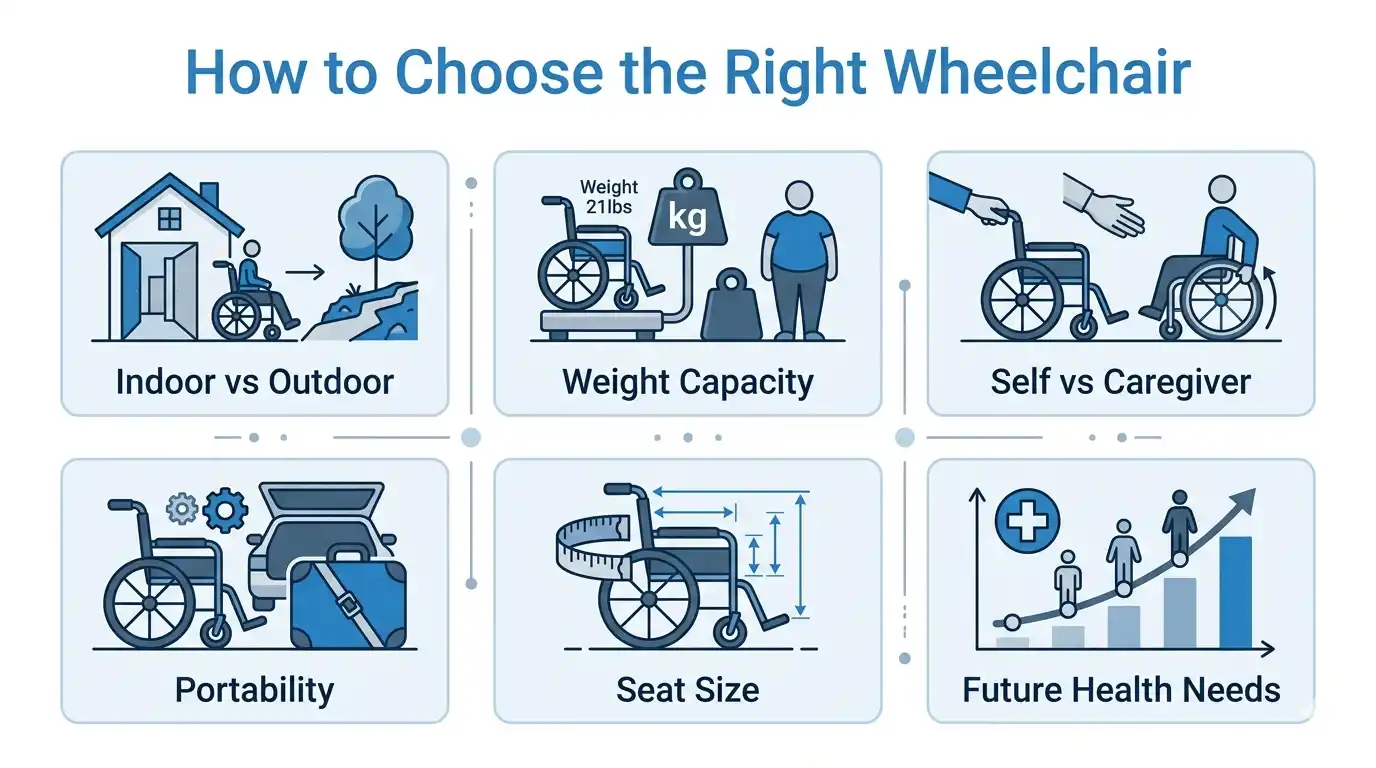
The most important factors when choosing a wheelchair for an elderly person are: seat size, weight capacity, intended use (indoor vs. outdoor), caregiver needs, and budget. Getting these right before you buy saves money and prevents unnecessary returns.
Here’s what to think through before ordering:
- Indoor vs. Outdoor Use Narrow hallways at home need a compact frame. Outdoor terrain sidewalks, grass, gravel needs larger wheels and stronger motors on power chairs.
- Self-Propelled or Caregiver-Assisted If the senior can’t self-propel, a transport chair or power chair makes more sense than a standard manual model.
- Weight Capacity Most standard wheelchairs hold 250–300 lbs. Bariatric wheelchairs handle 400–700 lbs. Don’t ignore this number.
- Portability Families who travel or live in smaller spaces need a chair that folds flat. Heavier power chairs require vehicle lifts.
- Future Health Changes Work with a physician on prognosis. A senior with early-stage Parkinson’s disease may need a power wheelchair within a year, even if a manual chair works today.
What Are the Key Features to Look for in a Wheelchair for Seniors?
The key features to look for in a senior wheelchair include: seat width and depth, armrest style, footrest type, wheel size, weight, and cushioning. These directly affect comfort, safety, and daily usability.
Seat Width and Depth Measure the senior’s hip width and add 2 inches. A seat that’s too narrow causes pressure sores. Too wide, and the user can’t reach the wheels to self-propel.
Armrests Flip-back or removable armrests make getting in and out of the chair much easier. Desk-length arms allow the chair to slide under tables.
Footrests Swing-away footrests clear the path during transfers. Elevating leg rests help seniors with swelling or poor circulation.
Cushioning A basic foam cushion works short-term. For long-term users, a pressure-relief cushion prevents sores especially important for seniors with diabetes or limited sensation.
Wheel Size Larger rear wheels allow self-propulsion. Smaller wheels (common on transport chairs) require someone else to push.
How to Ensure Proper Wheelchair Fit and Positioning for Seniors?
A properly fitted wheelchair keeps the senior’s hips at 90 degrees, feet flat on the footrests, and back fully supported. Poor fit leads to pressure sores, poor posture, and even falls during transfers.
Getting fit right matters more than the brand. Here’s a simple checklist:
- Seat width: hip width + 2 inches
- Seat depth: thigh length minus 2 inches (to avoid pressure behind the knee)
- Seat height: allows feet to rest flat on footrests
- Back height: supports the lower back without restricting arm movement
- Armrest height: elbows rest comfortably at 90 degrees
An occupational therapist or physical therapist can measure all of this. Many DME (durable medical equipment) suppliers offer fitting appointments too.
Wheelchair Comparison Table
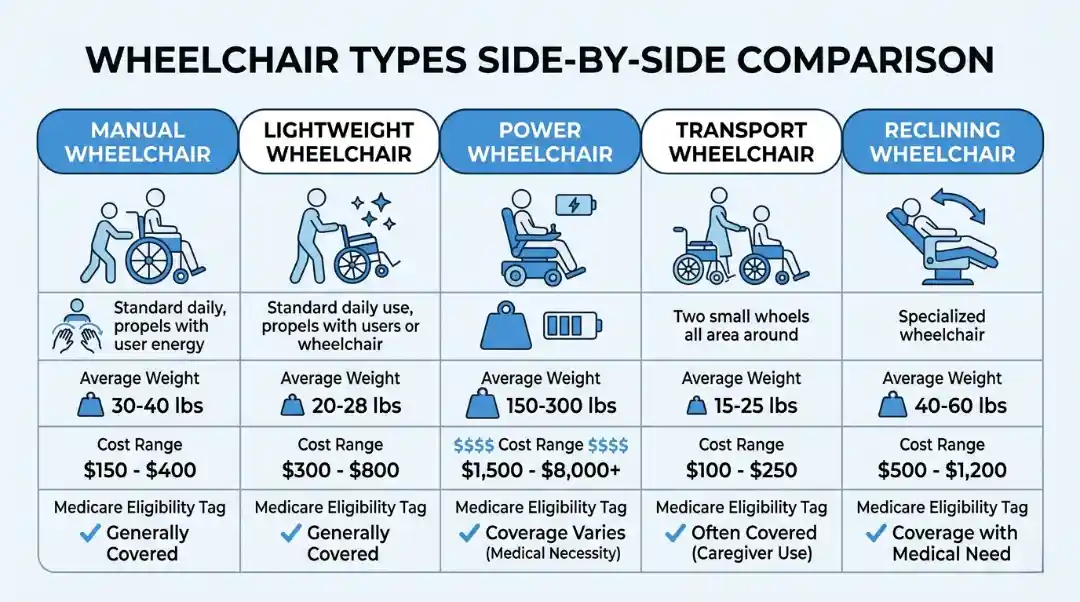
| Type | Best For | Avg. Weight | Avg. Cost | Medicare Eligible |
| Manual (standard) | Active seniors, caregiver-assisted | 25–40 lbs. | $100–$500 | Yes |
| Lightweight Manual | Travel, portability | 15–25 lbs. | $200–$800 | Yes |
| Power/Electric | Limited upper-body strength | 50–300 lbs. | $1,500–$15,000 | Yes (with docs) |
| Transport Chair | Short-term, travel | 15–25 lbs. | $80–$300 | Limited |
| Reclining | Extended sitting, pressure relief | 35–50 lbs. | $300–$1,200 | Yes |
| Bariatric | High weight capacity (400+ lbs.) | 40–70 lbs. | $300–$2,000 | Yes |
Does Medicare Cover Wheelchairs for Seniors?
Yes, Medicare Part B covers wheelchairs and power scooters when a doctor prescribes them as medically necessary. Medicare typically covers 80% of the approved cost after the deductible, meaning you pay roughly 20% out-of-pocket.
Here’s how it works in practice:
- Your doctor documents that you have a mobility-limiting condition
- They write a prescription for a wheelchair or power scooter
- You purchase from a Medicare-enrolled DME supplier
- Medicare Part B pays 80% of the approved amount
Does Medicaid cover wheelchairs? Yes Medicaid coverage varies by state but generally covers manual and power wheelchairs when deemed medically necessary. Call your state Medicaid office to confirm your specific benefits.
Are electric wheelchairs covered by Medicare? Power wheelchairs are covered under Medicare Part B, but you’ll need prior authorization and documentation showing you can’t use a cane, walker, or manual chair safely at home.
Power scooter vs. power wheelchair: Medicare treats these differently. A wheelchair motor scooter (mobility scooter) may not qualify if the medical documentation supports a power wheelchair instead. Your doctor’s prescription language matters significantly here.
Final Thoughts
Choosing a wheelchair doesn’t have to feel like a medical exam. Once you know the type that fits your situation, narrow down by seat size, weight capacity, and daily use pattern. Then confirm insurance coverage before you buy.
If you’re looking for extra support beyond mobility equipment, Castle Pines Home Care offers personalized home care services in Denver to help seniors maintain independence safely at home. From daily assistance to caregiver support, our team works alongside families, not just patients. Contact us today to learn how we can help.
Frequently Asked Questions
What type of wheelchair is best for elderly people?
The best type depends on the senior’s strength and condition. Manual wheelchairs suit those with good upper-body strength. Power wheelchairs work best for those with limited mobility or conditions like Parkinson’s disease. Transport chairs are ideal for short-term or travel use.
What is the lightest wheelchair for seniors?
The Karman 19.8 lbs. Ultra Lightweight is among the lightest options available. Several carbon-fiber models go even lighter at 15–17 lbs., though they cost significantly more.
Can I rent a wheelchair instead of buying one?
Yes. DME suppliers and some pharmacies offer short-term wheelchair rentals. Renting makes sense if you’re recovering from surgery and only need a chair temporarily.
How do I get a wheelchair through Medicaid?
Ask your doctor to prescribe a wheelchair and document your medical need. Then contact a Medicaid-enrolled DME supplier in your state. The process is similar to Medicare but varies by state coverage rules.
What is the difference between a transport wheelchair and a standard wheelchair?
A transport wheelchair has small wheels on all four corners; it can only be pushed by a caregiver. A standard manual wheelchair has large rear wheels the user can grip and self-propel.
Is a power scooter the same as a power wheelchair?
No. A jazzy electric wheelchair or standard power wheelchair is more maneuverable indoors and designed for medical use. A wheelchair motor scooter is better for outdoor use but less suited for tight indoor spaces. Medicare treats them as separate categories.