

Understanding the difference between short-term care and long-term care helps you pick the right support, protect your family finances, and keep your aging loved one safe. Short-term care acts as a temporary recovery bridge after a hospital stay, while long-term care provides continuous daily assistance for chronic conditions.
Choosing between short-term care vs long-term care comes down to your loved one’s recovery potential, health status, and overall care goals. When you understand how these two options function, you can skip the confusion and build a clear, confident plan for home care services.
What Is Short-Term Care?
Short-term care is temporary, high-intensity medical or non-medical assistance designed to help a person recover from a specific health event.
You’ll usually hear doctors call this post-acute care. The main goal here is functional recovery. It helps seniors regain their physical strength and independence so they can safely return to their normal daily lives.
A short-term care definition centers on brief, goal-oriented support. It steps in right after a crisis to prevent hospital readmissions.
Key Features of Short-Term Support
-
Duration: Stays usually run anywhere from a few days up to 12 weeks.
-
Primary Focus: Targeted rehabilitation, physical therapy, wound treatment, or temporary personal care.
-
Goal: Reaching a stable baseline of health so the person can care for themselves again.
What Is Long-Term Care?
Long-term care is ongoing, open-ended assistance provided to individuals who can no longer perform basic daily tasks independently due to chronic illness, disability, or cognitive decline.
Unlike recovery care, the primary goal of long-term care isn’t a quick cure. Instead, it focuses on health maintenance, personal safety, and preserving human dignity over an extended period.
Core Components of Long-Term Support
-
Duration: Spans months, years, or the remainder of a person’s life.
-
Primary Focus: Helping with basic self-care tasks and managing ongoing medical needs.
-
Goal: Keeping older adults comfortable, secure, and socially engaged while slowing functional decline.
Understanding Activities of Daily Living (ADLs)
Long-term support revolves around the six basic Activities of Daily Living (ADLs):
-
Bathing: Showering and personal hygiene.
-
Dressing: Choosing clothes and putting them on.
-
Eating: Feeding oneself meals.
-
Toileting: Getting on and off the toilet safely.
-
Transferring: Moving out of a bed or chair.
-
Continence: Managing bowel and bladder functions.
When aging parents struggle with two or more ADLs, long-term assistance usually becomes necessary.
Difference Between Short-Term Care and Long-Term Care
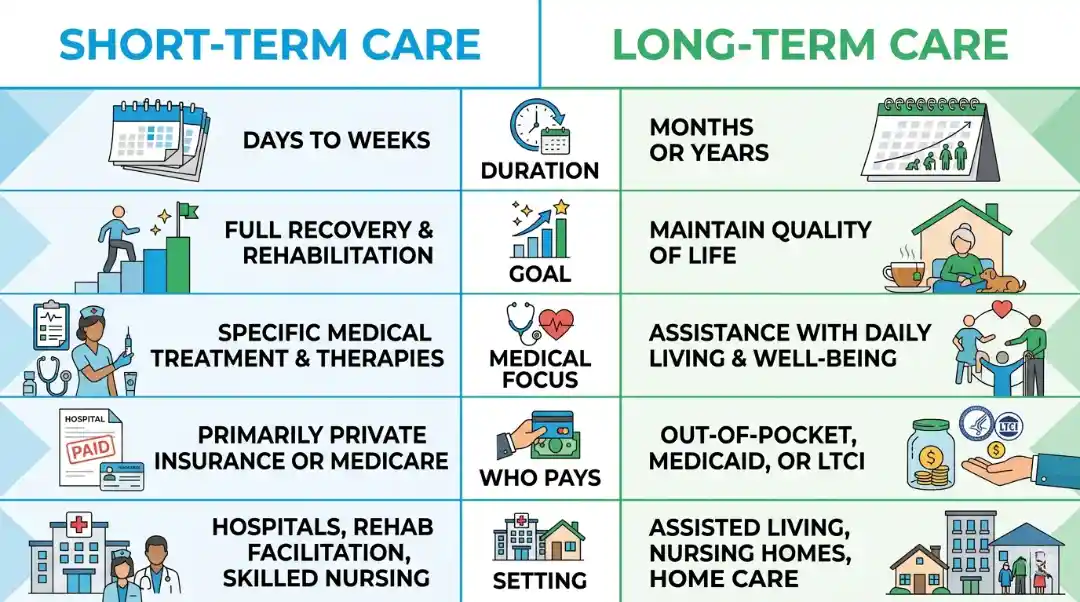
The clearest way to separate the two is by purpose. Short-term care fixes a temporary problem. Long-term care manages an ongoing one. Everything else, the setting, the cost, the paperwork, follows from that one distinction.
Here’s a side-by-side look:
| Factor | Short-Term Care | Long-Term Care |
|---|---|---|
| Purpose | Recovery and rehabilitation | Ongoing daily support |
| Typical length | Days to a few months | Months to years |
| Common triggers | Surgery, injury, illness | Chronic disease, dementia, disability |
| Where it happens | Home, rehab center, skilled nursing facility | Home, assisted living, nursing home |
| Who provides it | Nurses, therapists, home health aides | Caregivers, home health aides, nursing staff |
| Typical payer | Medicare, private insurance | Medicaid, long-term care insurance, private pay |
| End goal | Return to independence | Maintain safety and quality of life |
Notice the payer row. This trips up more families than anything else. Medicare covers short-term rehab in a skilled nursing facility, but only up to 100 days, and only after a qualifying hospital stay of at least three days. Long-term custodial care isn’t something Medicare pays for at all, which is exactly why this Short-Term Care vs Long-Term Care distinction matters so much when you’re budgeting.
When Does Short-Term Care Transition to Long-Term Care?
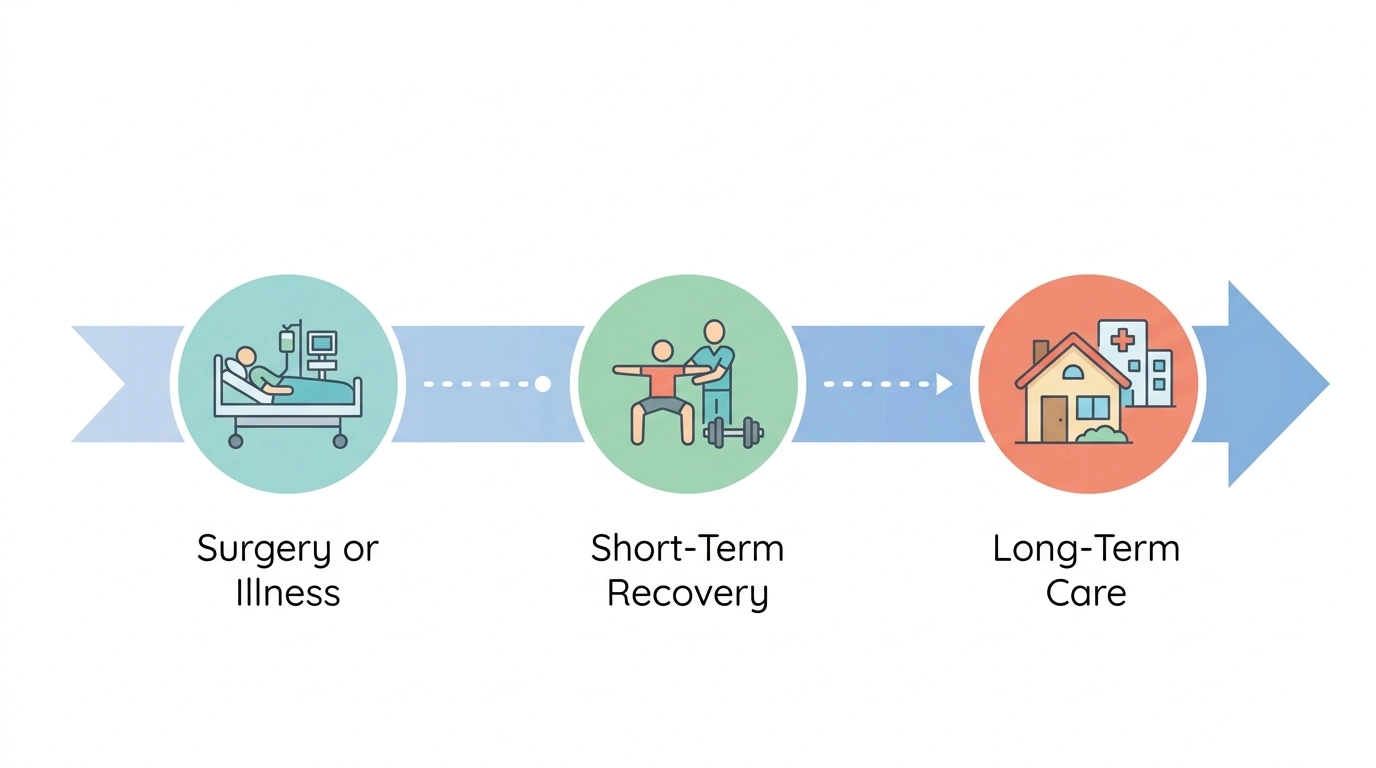
A short-term recovery plan transforms into long-term support when a patient’s physical progress levels off before they reach full independence.
This milestone is often called a recovery plateau. When physical therapy no longer creates measurable physical gains, insurance coverage for acute short-term rehab usually ends.
Common Transition Indicators
-
A stroke patient finishes 8 weeks of therapy but still requires full assistance to move from bed to chair.
-
A person with chronic illness experiences gradual memory loss, making it unsafe for them to stay alone.
-
An aging parent’s recovery from a broken bone stalls due to underlying severe arthritis.
Managing the Shift Smoothly
When short-term insurance coverage ends, care shouldn’t just stop. Family caregivers need to pivot quickly.
You can shift your loved one to maintenance therapy to preserve their mobility while bringing in non-medical home care aides to handle everyday daily tasks safely.
Cost Comparison: Short-Term Care vs Long-Term Care
Money matters here, and nobody should be blindsided by care costs.
Short-term care is often covered by Medicare Part A, but with conditions. Medicare typically covers up to 100 days in a skilled nursing facility following a qualifying hospital stay of at least 3 days. Days 1-20 are fully covered. Days 21-100 require a daily co-pay (around $200 in 2024). After day 100, coverage ends.
Long-term care is a different story. Medicare does not cover custodial long-term care. The main payment options include:
- Medicaid (for those who meet income and asset eligibility)
- Long-term care insurance (must be purchased before a diagnosis)
- Private pay / personal savings
- Veterans Administration benefits for qualifying vets
Early financial planning for long-term care isn’t pessimistic. It’s practical.
How to Choose Between Short-Term and Long-Term Care
Deciding on the right level of support requires a clear look at your loved one’s immediate health needs. Follow this simple 4-step checklist:
1. Evaluate Clinical Intent
Is the goal to heal an acute injury and return to full independence, or is it to manage an ongoing chronic illness?
-
If healing: Pick short-term care.
-
If managing ongoing decline: Choose long-term support.
2. Assess Daily Functional Abilities
Can your aging parent bathe, dress, and make meals on their own? Count how many ADLs require hands-on help. Needing constant daily help signals a need for long-term care.
3. Review Financial Coverage
Check your insurance policies. If you’re counting on Medicare, remember it only covers temporary skilled rehabilitation following a hospital stay.
4. Respect Personal Preferences
Ask where your loved one feels most comfortable. Most seniors prefer remaining in familiar home surroundings rather than moving into a residential care facility.
Finding the Right Care Support at Home
For families who want professional support without moving a loved one out of their home, in-home care is worth exploring. If you’re based in Colorado, Castle Pines Home Care offers trusted, compassionate home care services in Denver and surrounding areas. Whether you need short-term recovery care after a hospital stay or ongoing daily assistance for a loved one with chronic needs, having the right team makes all the difference.
Frequently Asked Questions
Does Medicare pay for long-term care in a nursing home?
Medicare doesn’t pay for long-term custodial care in a nursing home. It only pays for short-term skilled nursing care after a qualifying hospital stay, and only for up to 100 days under certain conditions.
What’s the difference between a skilled nursing facility and long-term care?
A skilled nursing facility (SNF) can provide both short-term rehabilitation and long-term care. The difference is the type of services being provided. Short-term SNF care is recovery-focused; long-term SNF care is maintenance and daily assistance.
Can a person receive long-term care at home?
Yes. Many people receive long-term care in their own home through professional caregivers, home health aides, or family members supported by care planning professionals.
How long does short-term care typically last?
Short-term care usually lasts anywhere from a few days to three months, depending on the condition being treated and the patient’s recovery progress.
What conditions typically require long-term care?
Conditions like Alzheimer’s disease, Parkinson’s disease, dementia, permanent physical disabilities, and degenerative neurological conditions most commonly require long-term care.
Is long-term care insurance worth it? Long-term care insurance can significantly reduce out-of-pocket costs for extended care needs. It’s most valuable when purchased before age 60 and before any diagnosis that could disqualify coverage.