

So the short answer is: there isn’t one-size-fits-all approach. What’s the greatest medical plan for seniors? It is dependent on your health, your money, and if you want to keep seeing the doctors you already trust. If you’ve spent an afternoon comparing Original Medicare, Medicare Advantage, and Medigap and starting feeling like you need a translator, you’re not alone. Most folks over 65 run into the same brick wall I did the first time I looked into this for a relative: too many acronyms, not enough simple talk.
Plain English, no sales pitch, I’ll go thru all the main options. By the end, you’ll know which questions to ask and which plan type fits your scenario, whether you’re managing a chronic condition, watching a fixed monthly budget, or purchasing coverage on behalf of a parent. Let’s start with how government health insurance for seniors truly works.
Key Takeaways
| Metric or Feature | Original Medicare + Medigap Plan G | Medicare Advantage (Part C) |
| Primary Beneficiary Suitability | Frequent medical needs, multi-state travel, multiple specialists | Stable health, budget-focused, prefers bundled extra benefits |
| Monthly Premium Range | Higher fixed cost (Part B + Medigap + Part D) | $0 or low monthly premium (+ standard Part B) |
| Provider Access Rules | Any doctor or hospital accepting Medicare nationwide | Restricted local HMO/PPO networks; referrals often required |
| Max Out-of-Pocket Risk | Extremely low ($283 Part B deductible in 2026) | Capped up to $9,250 in-network for 2026 |
| Supplemental Benefits | Dental, vision, hearing non-covered | Dental, vision, hearing, and gym perks usually bundled |
Understanding Your Medicare Options
Medicare is the government health insurance program for persons who are 65 or older and for some younger people with disabilities . It’s operated by the Centers for Medicare & Medicaid Services (CMS) and you enrolll via Medicare.gov or Social Security, not a private insurance shopping site. When you enroll, you’re not locked into one plan you can chose from several avenues of coverage.
Medicare is not one thing. Think of it more as a group of building blocks. You start with hospital and medical insurance and then select if you want to add a private plan on top.
What Counts as a “Medical Plan” for Seniors?
A medical plan for seniors is a health insurance policy designed to cover inpatient care, outpatient treatment, prescription medications, and routine health maintenance after age 65. These plans include federal Original Medicare, private Medicare Advantage options, Medigap policies, and drug benefit plans.
Understanding the specific building blocks ensures complete health coverage without unexpected coverage gaps:
- Part A (Hospital Insurance): Covers inpatient hospital stays, skilled nursing facility care, hospice, and limited home health services. Most individuals pay no monthly premium for Part A if they worked 10 or more years.
- Part B (Medical Insurance): Covers outpatient care, doctor visits, preventive services, lab work, and durable medical equipment. Part B requires a monthly premium.
- Part C (Medicare Advantage): A private alternative that bundles Part A, Part B, and usually Part D into an HMO or PPO network structure.
- Part D (Prescription Drug Coverage): Standalone insurance policies through private carriers that pay for retail and mail-order medications.
- Medigap (Medicare Supplement Insurance): Private policies that pay the copays, coinsurance, and deductibles left behind by Original Medicare.
The “Big Three” Paths to Medicare Coverage
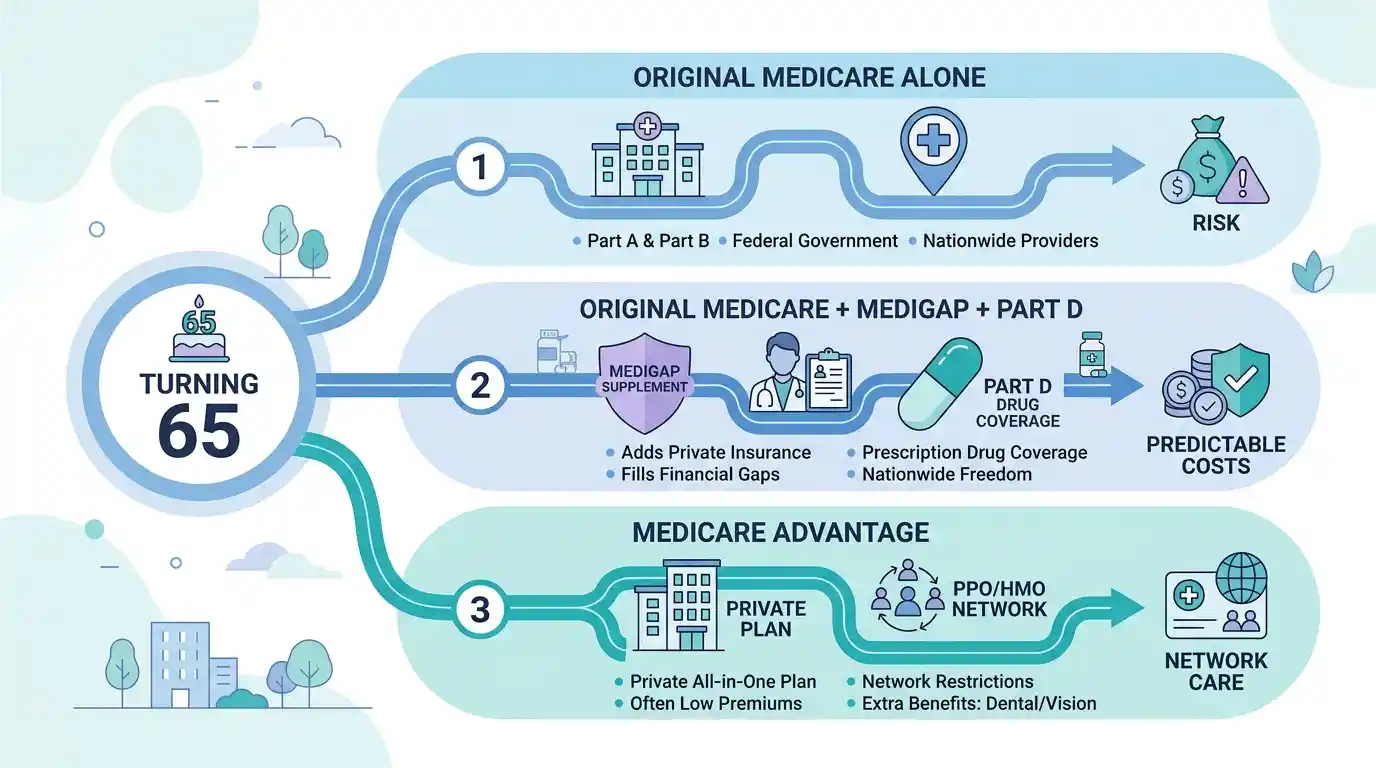
Seniors generally choose one of three structural approaches to assemble their health insurance coverage. Each path handles medical bills and doctor visits differently.
Path 1: Original Medicare Alone
This path relies strictly on federal Part A and Part B. While it offers complete freedom to see any provider accepting Medicare across the country, it leaves significant financial exposure. Original Medicare pays roughly 80% of covered outpatient costs.
You pay the remaining 20% with no annual out-of-pocket maximum limit. A single unexpected hospitalization or chronic illness can result in thousands of dollars in medical bills.
Path 2: Original Medicare + Medigap + Standalone Part D
This option combines government Medicare, a private Medigap supplement coverage and a Part D pharmaceutical plan. It is the most financially predictable and totally carefree.
You pay higher set rates each month but your medical expenditures are taken care of for the most part. You can go to any hospital in the country or see any specialist without bothering about referrals or networks.
Path 3: Medicare Advantage (Part C)
Medicare Advantage replaces Original Medicare with a private managed-care plan. Insurance carriers receive a fixed fee from the federal government to manage your care.
These plans usually offer $0 or very low monthly premiums alongside extra perks like basic dental, vision, and wellness allowances. However, care is restricted to local provider networks, and specialist visits often require prior authorization from the insurer.
Medicare Options Available to Seniors
When selecting health insurance for seniors, evaluating how each plan type handles routine visits, chronic medical conditions, and sudden emergencies reveals clear differences.
Medigap Plan G: Premier Protection
Medigap Plan G is the primary choice for beneficiaries seeking complete peace of mind. It covers all Medicare-approved deductibles and coinsurance except for the small annual Part B deductible.
Once that small deductible is met, you pay zero out-of-pocket for covered medical services for the rest of the year. Plan G also includes emergency health coverage during foreign travel.
Medigap Plan N: Balance of Cost and Value
Medigap Plan N offers lower monthly premiums than Plan G in exchange for minor cost-sharing. Beneficiaries pay small copays of up to $20 for routine doctor visits and up to $50 for emergency room visits that do not result in inpatient admission.
Plan N does not cover Part B excess charges rare instances where a doctor charges slightly more than the Medicare-approved rate. It suits seniors who are generally healthy and want lower fixed monthly costs.
Medicare Advantage HMO vs. PPO
Medicare Advantage plans come in two main structural varieties:
- HMO (Health Maintenance Organization): Requires you to select a primary care physician (PCP) who coordinates all care. You must see in-network doctors for non-emergency services and obtain referrals before booking specialist visits.
- PPO (Preferred Provider Organization): Offers greater flexibility by allowing you to receive care outside the plan network, though at higher copays or coinsurance rates. You generally do not need primary care referrals for specialist appointments.
Medicare Advantage vs. Medigap: Side-by-Side Comparison Table
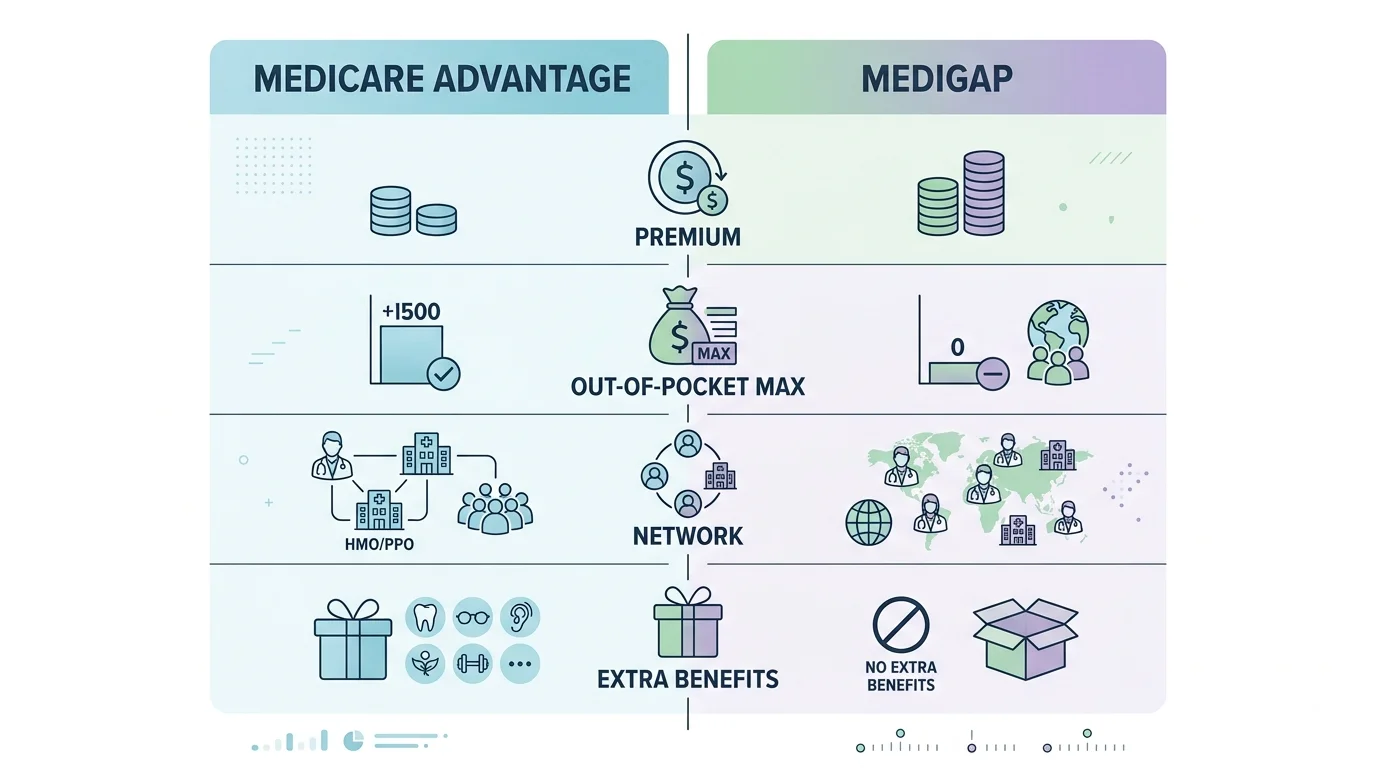
| Factor | Medicare Advantage | Original Medicare + Medigap |
| Monthly premium | Often low, sometimes $0 (plus Part B) | Higher (plus Part B) |
| Out-of-pocket max | Capped, varies by plan | Very low to near $0 with Plan G |
| Provider network | Restricted (HMO/PPO) | Any provider that accepts Medicare |
| Dental, vision, hearing | Usually included | Not included, needs separate coverage |
| Drug coverage | Usually bundled in | Requires a separate Part D plan |
| Travel coverage | Limited outside plan area | Nationwide, plus emergency coverage abroad |
Help for Seniors With Limited Income
Cost should not be a reason someone goes without care and there is more aid than most people know about. Seniors qualifying for both Medicare and Medicaid are referred to as dual eligible, and that combination can pay for most out-of-pocket payments. Even if you’re not quite eligible for Medicaid, you may still qualify for a Medicare Savings Program (MSP) that will pay your Part B cost.
There’s a program called Extra Help that reduces Part D premiums, deductibles and copays for persons with limited income and resources. Many qualified seniors don’t bother to apply because they think they make too much. It’s worth a five minute look on Medicare.gov or a call to your local State Health Insurance Assistance Program (SHIP).
How to Choose the Right Plan for You
There’s no shortcut that skips knowing your own situation first, and honestly, that’s the real answer to what is the best medical plan for seniors. Use this as a starting point, not a final answer.
- You travel often or split time between states: Original Medicare plus Medigap Plan G. No network to worry about anywhere you go.
- You’re generally healthy and want the lowest monthly cost: A $0 or low-premium Medicare Advantage plan, as long as your current doctors are in-network.
- You manage a chronic condition or see several specialists: Original Medicare plus Medigap, for predictable costs and no referral hoops.
- You want dental, vision, and hearing bundled in: Medicare Advantage plans typically include these; Medigap doesn’t.
- You live somewhere with thin provider networks: Original Medicare plus Medigap tends to hold up better in rural areas.
Whichever path fits, run the numbers with your actual doctors and prescriptions using the Medicare Plan Finder before you commit. A plan that looks cheap on paper can turn expensive fast if your specialist isn’t in-network or your medication isn’t on the formulary.
Common Mistakes Seniors Make When Picking a Plan
There are some faults that keep cropping up and most of them might be avoided. Missing the Medigap Open Enrollment window is the most expensive one, as it can mean medical underwriting for life. Another is passing on Part D because you don’t take many prescriptions – the late penalty follows you forever.
People also figure Original Medicare provides dental and vision, and it doesn’t. Others choose a Medicare Advantage plan based on premium alone, without verifying that their specialist is in the network. Hurry before enrollment closes and check each of these against your personal plan option.
Medication Reminder Services for Seniors
A solid medical plan gets your prescriptions filled and covered. It doesn’t get pills taken on schedule every day, and that gap causes real problems, especially for seniors managing multiple medications. Missed doses and mixed-up schedules send more people back to the hospital than most families expect.
This is where non-clinical, in-home support fills a real need that insurance simply doesn’t touch. A caregiver who checks in daily, sets out medications, and watches for side effects can catch problems before they turn into an ER visit. If you’re weighing options for a parent or a loved one, home care services in Denver through Castle Pines Home Care can pair with whatever medical plan you’ve chosen, covering the daily, hands-on part that Medicare was never designed to handle.
Final Thoughts
It’s not about getting the plan with the lowest price. It’s about getting the correct coverage that fits your actual doctors, health and budget. Original Medicare, Medicare Advantage and Medigap each solve a different problem. The “best” is the one that answers your problem. Review your individual drugs and providers using the Medicare Plan Finder before your enrollment window ends, and don’t skip Part D just because you’re feeling healthy today.
If you’re weighing a medical plan for yourself or a parent and want the daily, hands-on support that fills the gaps insurance leaves behind, contact us at Castle Pines Home Care to talk through what non-medical in-home care could look like alongside whatever coverage you choose.
Frequently Asked Questions
What is the most popular Medicare plan for seniors?
Medicare Advantage has grown into the more commonly chosen option in recent years, largely because of its lower premiums and bundled extras. Original Medicare paired with a Medigap plan still holds strong appeal for seniors who travel or manage complex health needs.
Is Medicare Advantage better than Original Medicare?
Neither one is universally better. Medicare Advantage tends to suit healthier seniors who want lower monthly costs and don’t mind a provider network, while Original Medicare with Medigap suits people who want to see any provider and avoid large, unpredictable bills.
Can I switch from Medicare Advantage back to Original Medicare?
Yes, during the Medicare Advantage Open Enrollment Period each year, typically January through March. Switching back to Original Medicare doesn’t guarantee you can add Medigap without medical underwriting, since your guaranteed-issue window may have already closed.
What does Medicare not cover?
Original Medicare doesn’t cover routine dental, vision, hearing aids, or most long-term custodial care. Some Medicare Advantage plans cover part of these, which is one reason people choose that path over Original Medicare alone.
When is the best time to enroll in Medicare?
Your Initial Enrollment Period runs from three months before to three months after your 65th birthday. Enrolling outside that window, without a qualifying special enrollment period, can trigger late penalties on both Part B and Part D that stick around for years.
Do I need an agent to choose a plan?
No, but a licensed, non-commissioned counselor through your local SHIP program can walk through your options for free. Agents can help too, just remember they’re often paid by the plans they sell, so it’s worth getting a second opinion before signing anything.