

When long-term care becomes necessary, figures don’t add up on paper. Social Security check alone won’t cover long-term care because average benefits hover near $2,000 monthly while care facilities charge over $9,000. You’ll need Medicaid to bridge that gap, which restructures how your monthly benefits get allocated.
If you’re trying to figure out how to pay for nursing home care with Social Security, you’re not alone. Balancing family caregiving responsibilities with complex federal benefit rules can feel overwhelming. This practical guide walks you through realistic funding strategies, exact program rules, and actionable steps to secure your loved one’s care without risking financial hardship.
How to Use Social Security to Pay for a Nursing Home Stay
Social Security benefits, including retirement, SSDI, and SSI, can be applied directly toward nursing home costs, since payments go to the recipient (or their representative payee) to use as needed. There’s no rule that blocks Social Security income from covering care. The bigger question is whether the check is large enough to matter.
Retirement benefits average close to $2,081 a month in 2026. SSDI averages a bit lower, around $1,580. SSI, which is need-based rather than work-based, tops out at $994 a month federally, though some states add a supplement on top of that. None of these numbers come close to covering a private nursing home bill by themselves.
That’s why families combine Social Security nursing home payment amounts with Medicaid, personal savings, or other benefits. Think of Social Security as one leg of a table. It holds weight, but it can’t stand alone.
How Much Does Nursing Home Care Actually Cost?
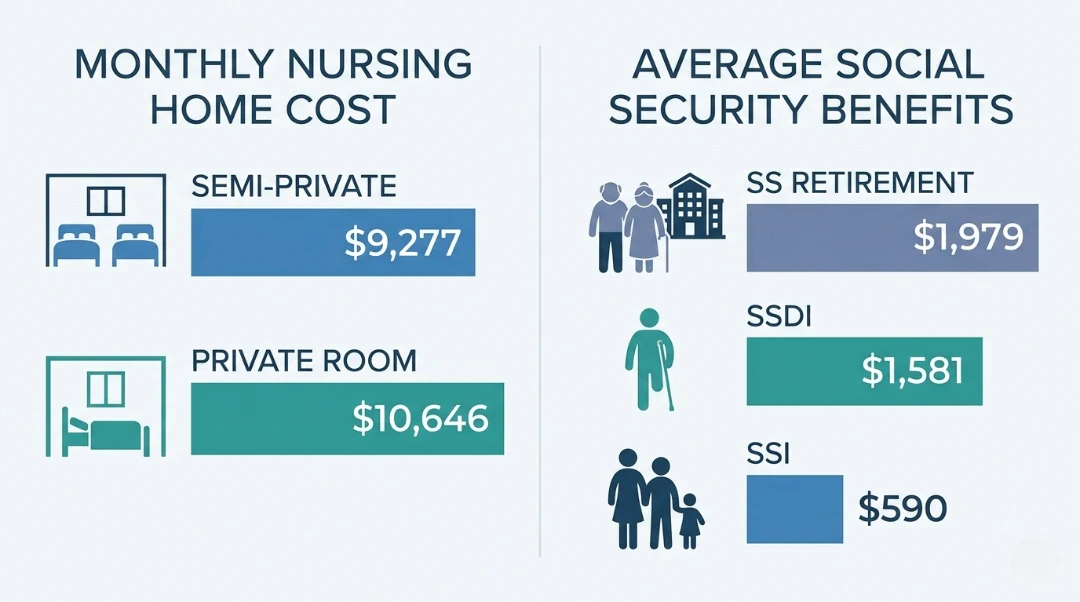
The national median cost for a semi-private room in a nursing home is $8,669 per month, while a private room averages $9,733 per month. These figures represent basic room and board alongside round-the-clock professional supervision, but the true out-of-pocket costs vary wildly based on your specific geographic location.
Local market rates dictate the actual price you will see on a monthly invoice. For instance, care facilities in certain southern states average closer to $7,500 monthly, while the identical level of care in northeastern states easily surpasses $14,000 every single month.
These standard monthly fees generally wrap multiple everyday necessities into one singular bill:
-
Twenty-four-hour clinical observation and skilled nursing care
-
Personal assistance with tasks like bathing, dressing, and using the restroom
-
Daily meals, routine housekeeping, and laundry services
-
Basic medical supplies and scheduled physical therapy sessions
So how much of that does Social Security actually cover? Let’s run the numbers:
| Benefit Type | Avg. Monthly (2025) | % of Semi-Private Room Covered |
| SS Retirement | $1,979 | ~21% |
| SSDI | $1,581 | ~17% |
| SSI | $590 | ~6% |
SSI covers the least on its own but SSI recipients usually qualify for Medicaid, which pays 100% of nursing home costs once eligibility is confirmed.
Social Security vs. Supplemental Security Income: What’s the Difference?
Social Security Disability or Retirement (SSDI/SSA) is an earned benefit based on your work history, while Supplemental Security Income (SSI) is a strict need-based welfare program funded by general tax revenues for low-income seniors and individuals with disabilities.
Understanding which benefit you receive determines how your money is handled upon entering a care facility:
-
Social Security (SSDI/Retirement): You earned this through payroll taxes over your working career. The entitlement stays yours regardless of your total assets or where you live.
-
Supplemental Security Income (SSI): Designed strictly for those with limited income and assets (typically under $2,000 for individuals).
When looking at how to pay for nursing home care with Social Security, your benefit type changes the rules completely. While earned Social Security checks remain the same amount, SSI payments drop dramatically once long-term institutional care begins.
Will Social Security Be Reduced While in a Nursing Home?
Retirement and SSDI checks aren’t reduced when someone enters a nursing home. SSI is different. It drops to $30 a month once Medicaid pays more than half the facility cost for a full calendar month. Some states add a small supplement on top of that.
So, do nursing homes take your Social Security check? Not directly. The Social Security Administration (SSA) sends the money to the beneficiary or an approved payee, and that person pays the facility. A nursing home generally can’t grab the deposit on its own.
The SSDI and nursing home question has the same answer as retirement. The check arrives at full value and goes toward the bill. Planning a short stay? SSI has an exception. If a doctor confirms the stay will last 90 days or less and the person will return home, SSI can continue, with conditions.
Report the move to SSA quickly. Late reports for SSI can lead to overpayments that someone must repay.
Can a Nursing Home Take Your Social Security Check?
The law prohibits a nursing home from taking your Social Security check, pension or any other income directly, except in rare cases where an account has gone into default and been sent to collections. Federal law protects those payments from being automatically seized.
What people are scared of vs. what happens. After Medicaid has paid for a stay, the resident’s income, including Social Security, goes toward the cost of care as “patient liability.” This is not a nursing home robbing a bank account. It’s part of how Medicaid decides what it will pay and what the resident pays. The resident keeps a small personal needs allowance, usually $30 to $100 depending on the state.
If your loved one cannot handle his or her own finances, someone (usually a family member but sometimes the facility itself) can be appointed as a representative payee to receive the check for him or her.
How Social Security Works When Medicaid Takes Over
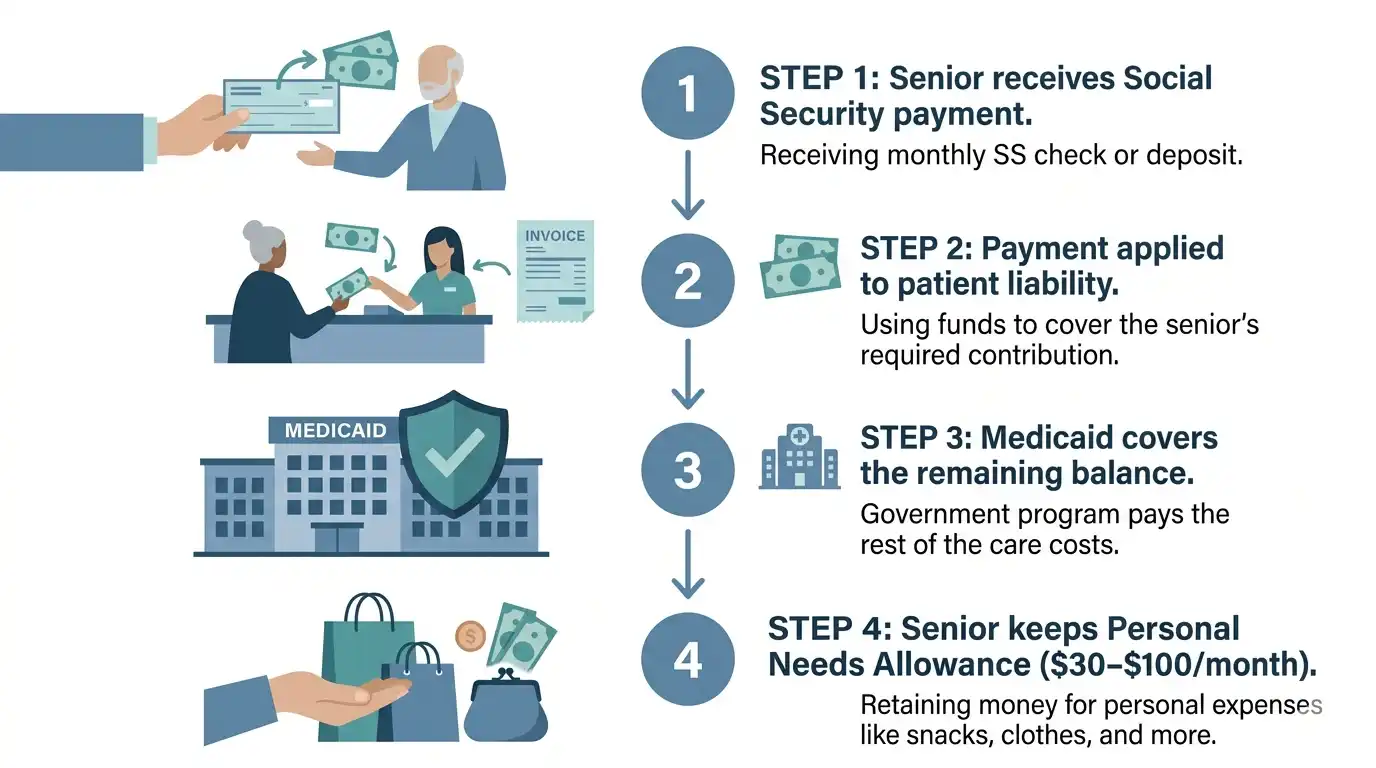
When Medicaid pays for nursing home care, your Social Security check isn’t confiscated, but you must pay nearly all of it directly to the facility as your required Patient Liability or Share of Cost.
Medicaid operates as the primary safety net for long-term care, but it requires you to contribute your available income toward your care before state funds kick in. Here is how that process works step-by-step:
-
Calculating Patient Liability: Medicaid calculates your gross income (including Social Security and any pensions).
-
Deducting Exemptions: Medicaid subtracts a small personal needs allowance (typically $30 to $100 depending on state law), Medicare premiums, and health insurance costs.
-
Paying the Facility: You pay the remaining balance of your Social Security check directly to the nursing home. Medicaid pays the facility the difference up to the state-approved rate.
Many families wonder: does a nursing home take your pension and social security? The facility doesn’t seize it outright, but Medicaid rules require you to hand over those monthly checks as your mandatory cost-share.
Is a Nursing Home the Right Option if Funds Are Limited?
A nursing home is right only when someone needs round-the-clock skilled nursing or medical care. If daily help with bathing, meals, and mobility is enough, assisted living or in-home care often costs less. A doctor’s assessment can show which level fits.
Some families pick a nursing home before checking other options. Assisted living has a national median near $6,200 a month, about $3,400 less than a shared nursing home room. In-home care can also cost less when someone needs only a few hours of help each day.
Picture a daughter whose dad falls and needs help. She books a nursing home, then learns his $2,100 check covers barely a fifth of the bill. A short assessment first might have shown that home care hours and a waiver fit better.
Medicaid waivers can also pay for services at home. Colorado’s Elderly, Blind and Disabled waiver, for example, supports people who qualify for nursing facility care but want to stay put. Ask your state Medicaid office or local Area Agency on Aging what’s available.
Other Ways to Pay for Nursing Home Care
Even when you know how to pay for nursing home care with Social Security, the check rarely stands alone. These sources often fill the gap:
- Savings and retirement accounts. Many families spend these first. IRA and 401(k) withdrawals can raise taxable income, so check the tax cost before pulling money.
- Long-term care insurance. Policies usually pay a daily or monthly benefit after a waiting period. Check the daily cap and start date.
- VA benefits. Wartime veterans and surviving spouses may qualify for the Aid and Attendance pension supplement. Ask a VA-accredited representative how to apply.
- Life insurance. Some policies offer accelerated benefits or a long-term care rider. Call the insurer to ask what’s available.
- Home equity. Selling the house can raise cash. A reverse mortgage usually comes due when the borrower moves out for good, so it rarely fits a nursing home stay.
How to Legally Manage a Loved One’s Social Security Benefits
When a senior experiences cognitive decline from conditions like dementia, they lose the ability to manage their own billing accounts. Families must establish legal authority to handle the incoming money.
1.Establish Power of Attorney:Prerequisite Step.
Have the senior sign a durable financial Power of Attorney (POA) while they still possess legal capacity. This grants you the power to manage private bank accounts and pay monthly facility bills.
2.File Form SSA-11 with the Government:Required for Federal Funds.
Be aware that the federal government does not recognize a standard POA for managing monthly benefits. You must file Form SSA-11 directly with the local office to become an official Representative Payee.
3.Open a Dedicated Payee Account:Banking Setup.
Set up a specific bank account titled along the lines of “[Senior’s Name] by [Your Name], Representative Payee.” This keeps federal benefits completely separate from your personal cash.
4.Direct the Monthly Deposits:Final Activation.
Route the monthly checks into this new account. Use these funds exclusively for the senior’s care costs, keeping careful records for annual government reports.
Does Social Security Pay for Other Senior Living Options?
Yes. Social Security benefits can be used to pay for assisted living, memory care, in-home care, and adult day services not just nursing homes. There is no rule restricting Social Security payments to nursing facility use only.
Many families find that assisted living or in-home care is a better fit financially. The monthly costs are lower, and Social Security benefits go further. If your loved one qualifies for SSI, they likely also qualify for Medicaid home and community-based services, which can fund in-home personal care in most states.
For families in Colorado, our team at Castle Pines Home Care provides professional, compassionate in-home support that allows seniors to stay in their own homes longer. If you’re weighing nursing home placement against in-home care, our home care services in Denver can be a meaningful alternative often at a fraction of the nursing home cost.
Step-by-Step: What to Do When Social Security Isn’t Enough
When monthly care costs exceed your Social Security income, act quickly to secure secondary funding and protect family assets from improper spend-down.
-
Review Monthly Income and Assets: Gather bank statements, pension details, and Social Security award letters to calculate your actual monthly gap.
-
Consult an Elder Law Attorney or Medicaid Planner: Get professional guidance on look-back rules (usually 5 years) to avoid penalties when transferring assets.
-
Apply for Medicaid Early: The application process takes months. Starting early prevents unpaid nursing home balances from accumulating.
-
Evaluate Non-Clinical Alternatives: If skilled 24-hour nursing isn’t strictly necessary, look into home-based support options covered by state waivers or personal funds.
Final Thoughts
Figuring out how to pay for nursing home care with social security is one of the most stressful financial challenges a family can face. The costs are real, and the paperwork feels endless. But the options exist Social Security, Medicaid, Veterans benefits, Medicare, and private insurance can all play a role.
The smartest move is to start planning before a crisis hits. Talk to an elder law attorney. Apply for every benefit your loved one qualifies for. And if in-home care is a viable option, it’s often a better financial and emotional choice than a nursing home.
If you’re in the Denver area and exploring alternatives to nursing home placement, contact us Castle Pines Home Care today. We help families find the right level of care at the right cost.
Frequently Asked Questions
Do nursing homes take your social security check?
Nursing homes do not take your check automatically, but if Medicaid pays for your care, you must hand over most of your Social Security income as your share of cost. You keep only a small personal needs allowance each month.
How much will Social Security pay for nursing home care per month?
Social Security pays your standard monthly entitlement amount. It does not pay extra funds specifically for nursing care, meaning Medicaid or private funds must cover the remaining balance.
Can Medicaid take my home if my Social Security pays the nursing home?
Medicaid generally ignores your primary home during your lifetime if a spouse lives there or you intend to return. However, after your death, the state may seek reimbursement from your estate through the Medicaid Estate Recovery Program.
What is the Medicaid look-back period?
In most states, Medicaid reviews all financial transactions from the past 5 years (60 months) prior to your application date. Giving away assets or selling property below market value during this window triggers penalty periods of ineligibility.
What is the Medicaid 5-year look-back period?
Medicaid reviews any asset transfers made within five years of the application date. Transfers made to reduce assets and qualify for Medicaid faster can result in a penalty period during which Medicaid won’t cover costs. An elder law attorney can help you avoid common mistakes.