

The demands of ongoing care, together with work and home life, and managing family caregivingresponsibilities, often bring up a feeling of self-doubt overpowering you. You may continually doubt if you are giving enough support or making the proper choices for your loved ones.
The first step to learning how to handle parental guilt is to realize that perfection in parenting is an unattainable standard to meet on a daily basis. By realigning your expectations, setting healthy boundaries and building in breathing room you are able to establish a healthier, more balanced home atmosphere for all of your family members.
What Is Parental Guilt?
Parental guilt is the emotional weight adult children feel when they believe they aren’t doing enough for an aging parent, whether that’s due to time, distance, money, or simply needing outside help. It often shows up as self-doubt, regret, or a fear of being judged by family or by the parent themselves.
This kind of guilt rarely comes from doing something wrong. It usually comes from an impossible standard: the idea that a “good” son or daughter should be able to do it all, without help, without complaint, and without a break. Once you name that standard for what it is, an unrealistic one, the guilt starts to loosen its grip.
How to Deal With Parental Guilt: 8 Practical Strategies
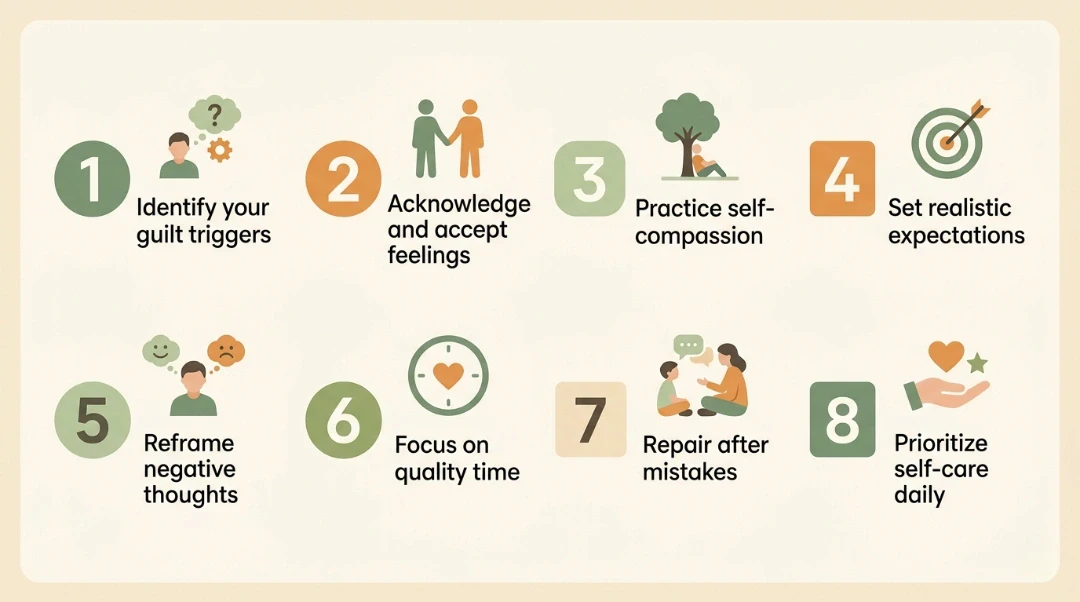
Knowing the causes is only half the picture. Here’s how to deal with parental guilt in ways that actually hold up over time, not just in the moment you read them.
1. Separate Guilt From Facts
Ask yourself: did I actually do something wrong, or does this just feel uncomfortable? Real guilt calls for an apology or a fix. False guilt, the kind tied to unrealistic expectations, calls for a mindset shift instead. Writing the situation down on paper often makes the difference clearer than replaying it in your head.
2. Talk Openly With Your Family
Silence lets resentment grow on both sides. A short, honest conversation with siblings or your parent about what you can realistically offer prevents a lot of misunderstanding later. Even a simple check-in call, where everyone shares what they can and can’t take on, cuts down on assumptions that fuel guilt.
3. Set Boundaries Without Apologizing
You can love your parent and still say no to a request that isn’t sustainable. Boundaries aren’t rejection; they’re what keeps you able to show up consistently. A boundary stated calmly, without a long list of excuses, tends to land better than one buried in apology.
4. Ask for Help Before You Burn Out
Waiting until you’re exhausted to ask for support usually means asking too late. Reach out to family, a caregiver support group, or a home care provider while you still have the energy to make a good decision. Early planning also gives your parent time to adjust to the idea of outside help rather than facing it during a crisis.
5. Reframe What “Good Care” Looks Like
Good care doesn’t mean doing everything yourself. It means your parent is safe, comfortable, and supported, regardless of who’s providing the day-to-day help. A trained caregiver handling meals or mobility support isn’t a substitute for love; it’s simply a different way of showing it.
6. Keep a Support System Close
Other caregivers understand this guilt in a way friends without the experience often don’t. A support group, whether in person or online, gives you a place to vent without judgment. Many hospitals, senior centers, and organizations like the Family Caregiver Alliance run free groups specifically for this purpose.
7. Take Breaks Without Guilt
Stepping away for a weekend or even an afternoon isn’t selfish. It’s what allows you to keep showing up for your parent without resentment building underneath. Respite care, whether from a family member or a home care agency, exists specifically to make this possible.
8. Get Professional Support When Needed
If guilt is affecting your sleep, mood, or relationships, a therapist can help you work through it directly instead of carrying it indefinitely. Some caregivers wait years before reaching out, only to find the relief comes faster than they expected once they finally do.
Signs You’re Experiencing Parental Guilt
Caregiver self-doubt rarely stays hidden; it spills over into daily choices, physical health, and personal relationships. Spotting these signs early helps you make positive adjustments before burnout sets in completely.
-
Constant Self-Criticism: Replaying minor daily interactions in your head and focusing only on what went wrong.
-
Overcompensating: Saying “yes” to every demand or buying gifts to make up for taking time for yourself.
-
Difficulty Setting Boundaries: Feeling intense remorse whenever you enforce necessary house rules or quiet hours.
-
Physical Exhaustion: Experiencing muscle tension, frequent headaches, or insomnia driven by racing thoughts at night.
-
Resentment Toward Loved Ones: Feeling frustrated with family members because you are giving away all your energy without saving any for yourself.
Characteristics of Parental Guilt
To manage this feeling, it helps to see its shape clearly. These patterns tend to repeat across most parents dealing with guilt, regardless of income, family structure, or how many kids are in the house.
| Characteristic | How It Shows Up |
|---|---|
| Cognitive distortion | Treating a normal daily hiccup as proof of personal failure |
| Role strain | Feeling like you’re failing at work when home, and failing at home when at work |
| Social withdrawal | Avoiding other families out of fear they’ll judge your situation |
| Weak boundaries | Avoiding fair limits because you fear they’ll damage the relationship |
Common Signs You’re Struggling With Parental Guilt
The clearest sign of struggling with parental guilt is a pattern of self-criticism that doesn’t match the size of the actual situation. You snap once and label yourself a bad parent for the rest of the week. That kind of overcorrection is a signal worth paying attention to.
Watch for these patterns in yourself:
- You apologize to your kids constantly, even for normal parenting decisions
- You overcompensate with gifts or leniency after feeling guilty
- You avoid time with friends or hobbies because it feels selfish
- You seek repeated reassurance from your partner or your child that you’re “doing okay”
- You feel anxious or low most days, not just occasionally stressed
If several of these sound like your week, it’s worth slowing down and taking a closer look at where the guilt is coming from.
Causes of Parental Guilt
The primary causes of parental guilt are the internal pressure of unrealistic expectations and the external pressure of societal comparison. Many caregivers struggle to balance their limited time and energy against the idealized standards of perfect caregiving shown on social media and in parenting guides.
To dismantle these feelings, we need to understand where they actually come from.
Internal Pressures: The Perfect Caregiver Myth
Many of us hold onto a picture-perfect idea of what a caregiver should be. We expect ourselves to be endlessly patient, always cheerful, and completely self-sacrificing. When real life gets messy, we view our normal human limits as personal flaws rather than practical boundaries.
External Pressures: The Social Media Mirror
We live in a world of highly curated highlights. When you see perfectly clean homes and structured daily activities online, it is easy to feel like you are falling behind. This constant comparison fuels maternal guilt and paternal guilt, making us forget that real caregiving involves clutter, noise, and unexpected changes.
Impact of Parental Guilt on You and Your Family
Left unchecked, parent guilt doesn’t just sit quietly in the background. It changes how you parent and how you feel day to day.
Some of the more common effects include:
- Overcompensating: Giving in more, buying more, or avoiding discipline to make up for guilt
- Lower self-worth: Viewing yourself as a failure even in areas where you’re doing fine
- Reduced presence: Guilt pulls your attention inward, away from actually enjoying your kids
- Strained relationships: Chronic guilt often spills into tension with a partner or friends
- Physical and mental toll: Ongoing guilt is linked to anxiety, burnout, and sleep problems
None of this means guilt makes you a bad parent. It means unmanaged guilt has real costs, and that’s exactly why learning how to deal with parental guilt matters as much as any other parenting skill.
Healthy Guilt vs. Toxic Guilt
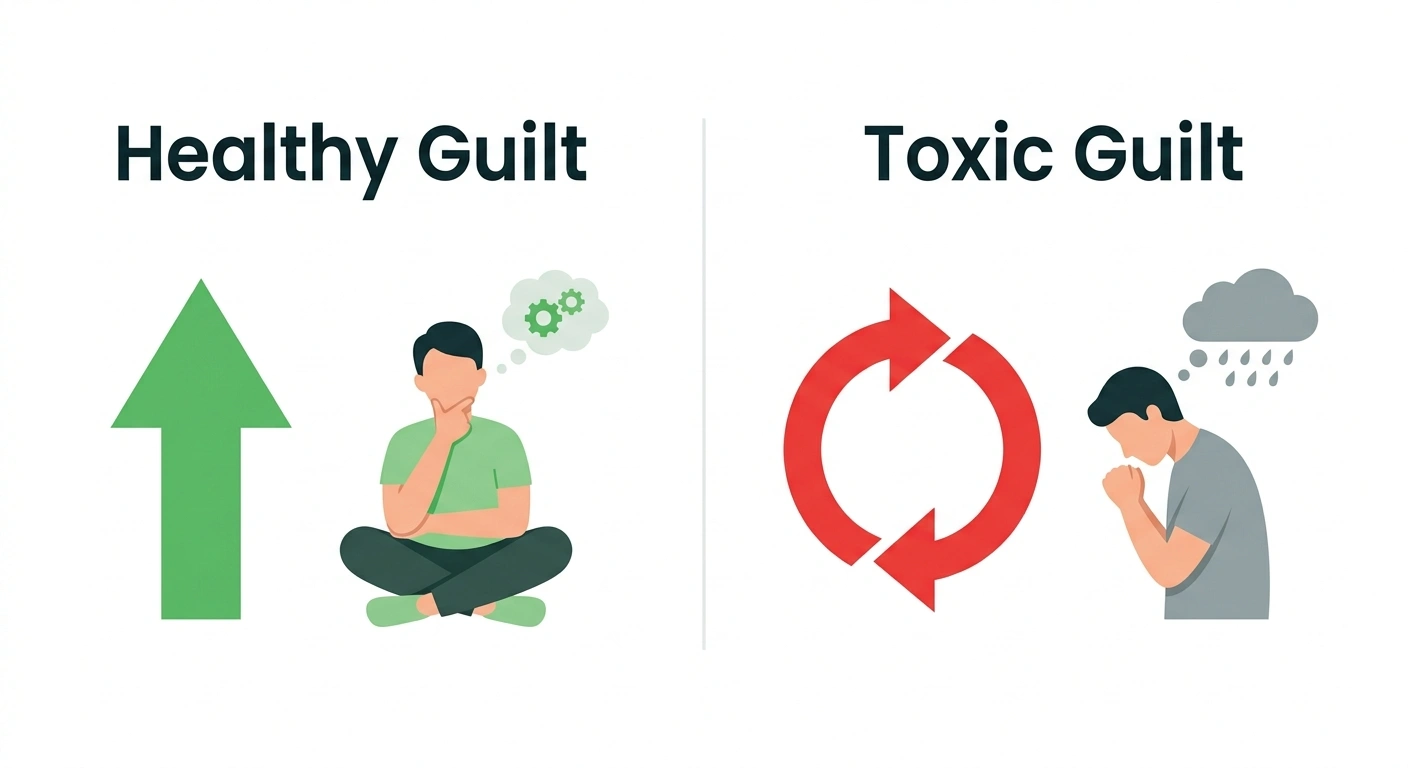
Not all guilt works against you. The difference between the two types decides whether guilt pushes you forward or keeps you stuck.
| Healthy Guilt | Toxic Guilt |
|---|---|
| Signals something needs to change | Lingers even after you’ve made it right |
| Motivates better behavior next time | Keeps you stuck in self-punishment |
| Fades after acknowledgment and repair | Feeds on itself and grows |
| Tied to a specific action | Becomes part of your identity |
| Leads to growth | Leads to shame and withdrawal |
Healthy guilt says, “I made a mistake, let me fix it.” Toxic guilt says, “I am the mistake.” That shift, from behavior to identity, is where guilt turns into shame, and shame is much harder to shake off on your own.
Therapy for Parents Dealing With Guilt and Frustration
Therapy for parents dealing with guilt and frustration typically involves cognitive behavioral techniques that help identify unrealistic thinking patterns and replace them with more balanced ones. A licensed therapist can also help caregivers process grief, anger, and exhaustion that often accompany long-term caregiving.
Cognitive behavioral therapy, or CBT, is one of the more common approaches, since it directly targets the self-critical thoughts that fuel guilt. Some therapists also use acceptance and commitment therapy, which focuses less on eliminating guilt and more on not letting it control your decisions. Support groups run through local hospitals or organizations such as the Family Caregiver Alliance offer a lower-cost option for caregivers who aren’t ready for one-on-one therapy.
Do You Keep Beating Yourself Up Over Past Mistakes?
Your mind goes into a habit of retrospective bias, where you assume you knew then what you know now, and you keep beating yourself up for past failures. This cognitive distortion leads you to judge your past behavior based on your current experience, which is unfair to start with.It is easy to look back on the early stages of a loved one’s illness or aging process and wish you had done things differently. Maybe you missed the first indicators of cognitive decline, or maybe you procrastinated in seeking professional support systems, waiting for things to get better on their own. This kind of parenting remorse may eat at you, leaving you with the feeling that you alone are responsible for the way things turned out. To end this loop, you need to exercise forgiveness towards yourself. You made the best judgments you could with the information, time, and emotional resources you had at the time. Accepting responsibility for your former self, according to your current perspective, merely keeps you in your current emotional distress.
When to Seek Professional Help
Sometimes parenting with guilt crosses into something that needs more than self-help strategies. If guilt is causing persistent sleep disruption, affecting your appetite, contributing to depression, or making you emotionally unavailable to your child that’s a signal to reach out to a mental health professional.
CBT is particularly effective at addressing the cognitive distortions (all-or-nothing thinking, catastrophising) that fuel chronic parental guilt. A therapist can help you separate realistic concern from excessive self-blame.
If you’re in the Denver area and looking for additional family support, Castle Pines Home Care offers compassionate home care services designed to ease the load on families. Connecting with Home Care in Denver can be a practical step in building the support system every parent deserves.
Final Thoughts
One of the most frequent feelings parents have is guilt, yet it’s not something they talk about very often. You aren’t failing. It usually means you care a lot. The idea isn’t to get rid of guilt completely; it’s to stop letting it control your life. When you find yourself in that spiral, remember this basic truth: your child doesn’t require a flawless parent. They need you to be there, be honest, and try.
You don’t have to figure out how to deal with parental guilt on your own if it’s too much for you to handle. Castle Pines Home Care is available to help families who have a lot on their plate. If you need help with daily tasks around the house or just want to make things easier, get in touch with our staff. Contact us today because asking for help doesn’t mean you’re weak. It’s one of the best choices you can make as a parent.
Frequently Asked Questions
Is parental guilt normal?
Yes. Research consistently shows that the overwhelming majority of parents across all demographics experience parental guilt at some point. It becomes a concern only when it’s chronic and leads to shame, burnout, or harmful behaviour patterns.
What’s the difference between guilt and shame in parenting?
Guilt is feeling bad about a specific action (“I shouldn’t have yelled”). Shame is feeling bad about who you are as a person (“I’m a terrible parent”). Guilt can motivate positive change. Shame tends to paralyse.
Can parental guilt affect my child?
Yes, indirectly. When a parent is caught in chronic guilt or a shame spiral, it reduces their emotional availability. Children are sensitive to parental emotional states, and a parent’s anxiety or disconnection affects a child’s sense of security.
Why do mothers experience more guilt than fathers?
Cultural and societal norms impose a greater caregiving responsibility on mothers. Studies published in the Journal of Family Issues and comparable journals indicate that mothers are more prone to scrutiny and self-criticism over time spent away from their children, even when such time is dedicated to employment.
How do I stop feeling guilty for working?
Change the way you think about your work. You’re not leaving your child behind; you’re taking care of them, teaching them how to work hard, and helping them become more independent. Often, the quality of time is more important than the amount. Research on working women and child outcomes repeatedly indicates that children thrive when parents are emotionally available, even if they are not physically present at all times.
What is mom guilt, specifically?
Mom guilt is the version of parental guilt that tends to affect mothers most acutely, driven by the cultural expectation that mothers should be fully available and self-sacrificing at all times. It’s the inner critic that shows up when a mother prioritises herself, her career, or her wellbeing in any way.