Finding the right path for an aging family member feels like walking through a heavy fog. You want safety, comfort, and peace of mind, but the endless terminology makes an already hard time feel overwhelming. Choosing between standard supportive housing and specialized dementia support is one of the biggest choices you’ll face.
Making the wrong pick costs precious time, money, and emotional energy. In this guide, we’ll break down how both options handle daily tasks, safety setup, staffing levels, and total costs. By the end, you’ll know exactly which environment fits your family member’s current needs and how to plan for the future.
What Is Assisted Living?
Assisted living offers personal care support, social activities, and private apartments for seniors needing help with basic daily tasks. It combines housing with individual support to help residents keep their independence as long as possible. Staff members assist with bathing, dressing, medication reminders, and general mobility.
It acts as a bridge between living independently and living in a full clinical nursing home. Residents typically have their own private or semi-private apartments. They eat meals together in shared dining spaces and participate in structured group outings.
The daily focus centers on balance and social engagement. If your parent can manage their own calendar but needs help buttoning a shirt, managing medications, or preparing meals, this environment offers just enough backup. It gives them support without taking away their personal freedom.
| Feature Area | Assisted Living Setup | Memory Care Setup |
| Primary Focus | Physical aid & daily tasks | Cognitive safety & dementia care |
| Building Design | Open campus, multi-story | Secured doors, circular hallways |
| Staff Training | General personal care | Specialized memory impairment |
| Staff Ratio | 1 staff per 10–15 residents | 1 staff per 5–8 residents |
| Average Monthly Cost | ~$4,800 / month | ~$5,900 / month |
What Is Memory Care?

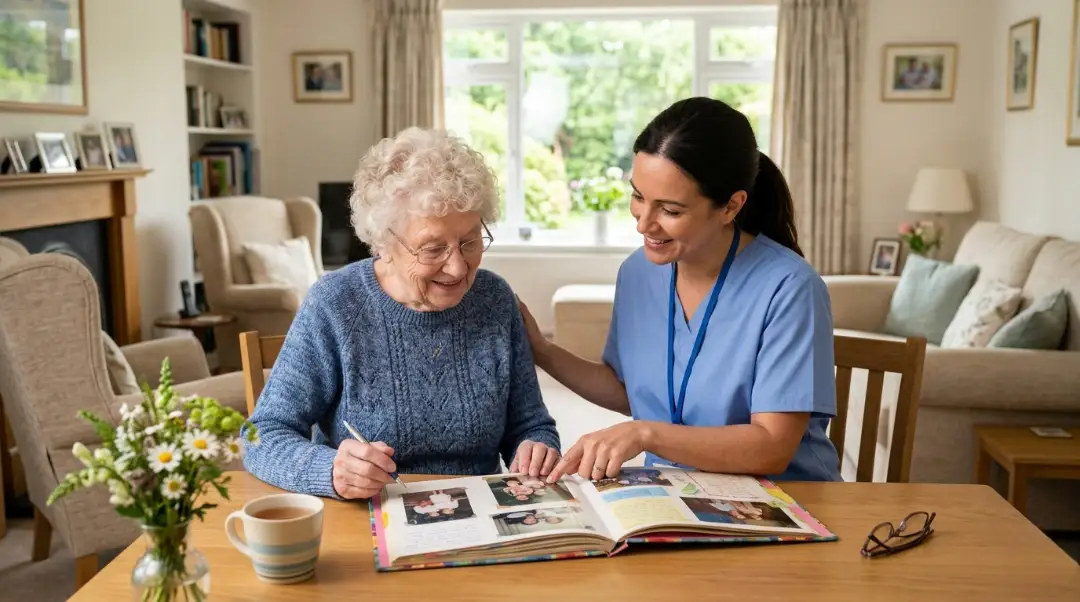
A memory care caregiver engages a senior resident in a calm, structured environment
Memory Care is an assisted living community that provides specialised care for those with Alzheimer’s disease, dementia, or severe cognitive impairments. It has a locked memory care unit, well-organised daily schedules and heavy supervision. All aspects include resident safety, behaviour control, and specific cognitive support.
These surroundings are different because safety remains the highest operational concern. Families seek out these services when cognitive changes lead to structural safety hazards at home. Here, residents need continuous instruction and clear, predictable rhythms to reduce their everyday uncertainty.
In these specialised wings, the personnel receive extensive training specifically for working with individuals with dementia. They are trained in nonverbal communication methods, validation approaches, and behavioural redirection strategies. This helps individuals deescalate situations of anxiety, pacing or restlessness without stress.
A memory care director can create customised therapeutic schedules to help keep the brain active. The rhythm of the daily calendar produces a sense of tranquillity through sensory stimulation and organised physical tasks. This dedicated care structure is specifically designed to cater to the complicated symptoms of increasing memory loss.
The Key Differences Between Assisted Living and Memory Care
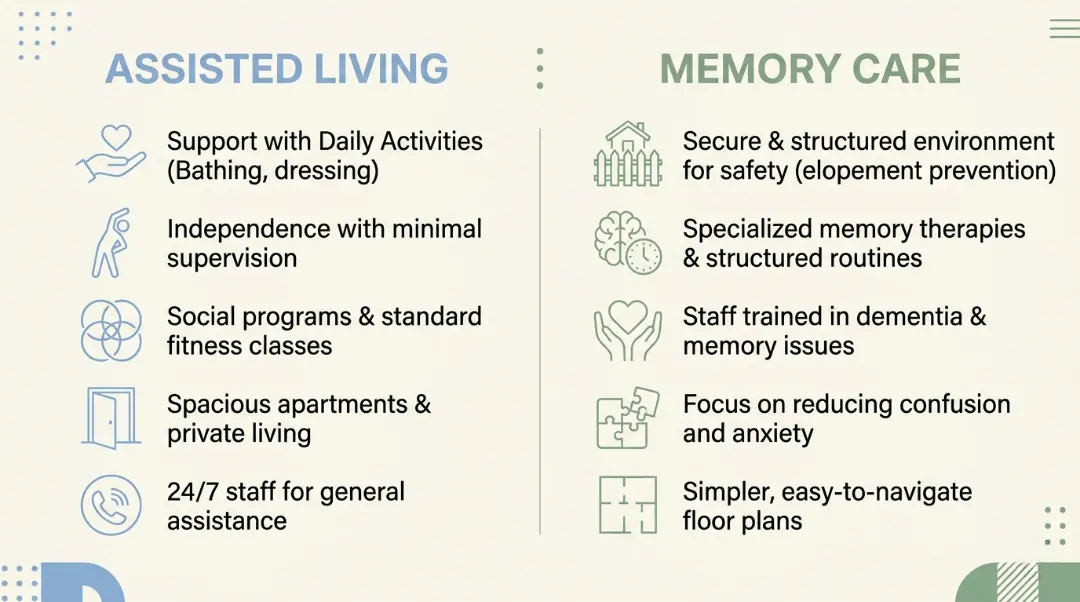
Understanding the exact split between these settings helps prevent a premature placement. The core distinction centers on the root cause of the care needs. Assisted living solves physical limitations, while memory care addresses structural cognitive decline.
When analyzing assisted living vs memory care pathways, look closely at the physical freedom allowed. Assisted living residents can leave the building freely, sign out for family dinners, or walk the grounds. Memory care residents live within secure walls to eliminate dangerous exit-seeking behavior.
The clinical support also varies between the two options. Assisted living centers provide scheduled wellness checks and basic nursing support during standard business hours. Memory care requires continuous, high-level supervision because residents may no longer recognize basic environmental dangers.
The physical design of the building represents another major point of separation. Memory care buildings use specific interior architecture to lower anxiety. You will find circular walking paths so residents never hit confusing dead ends, along with heavily disguised exit doors to prevent elopement.
Assisted Living vs Memory Care: Side-by-Side Comparison
Reading definitions only gets you so far. Here’s how memory care vs assisted living actually breaks down once you put the two next to each other.
| Feature | Assisted Living | Memory Care |
|---|---|---|
| Who it’s for | Seniors who need help with daily tasks but are cognitively intact | Seniors with Alzheimer’s, dementia, or significant memory loss |
| Living space | Private or semi-private apartment | Smaller private or shared rooms, often near common areas |
| Security | Standard building security | Secured entrances, alarmed doors, enclosed outdoor areas |
| Staff training | General caregiving | Specific dementia and behavioral training |
| Staff-to-resident ratio | Lower | Higher |
| Daily structure | Flexible, resident-driven | Structured routines to reduce confusion |
| Median monthly cost (2026) | $5,419 | $6,690 |
| Typical length of stay | Years, until needs increase | Until end of life, in most cases |
The line that trips people up most is “cognitively intact.” Plenty of assisted living residents have mild memory issues. What tips someone into needing memory care isn’t forgetfulness alone, it’s forgetfulness that creates real risk: wandering off, forgetting to eat, or not recognizing a dangerous situation.
Signs It’s Time to Move from Assisted Living to Memory Care
Families rarely make this move because of one big event. It’s usually a string of smaller ones that finally add up. Watch for:
- Wandering or getting lost, even in familiar places like the community hallway or parking lot.
- Medication mix-ups, taking a dose twice or forgetting it entirely despite reminders.
- Safety incidents, like leaving a stove on, falling more often, or letting strangers into their apartment.
- Increased agitation or aggression, especially in the late afternoon or evening, sometimes called sundowning.
- Not recognizing family members or becoming confused about where they are.
- Weight loss, from forgetting to eat or losing the ability to follow through on a meal.
If two or three of these sound familiar, it’s worth having the assisted living vs memory care conversation with the community’s staff and your parent’s doctor, sooner rather than later. Alzheimer’s and related dementias affect an estimated 7.4 million Americans age 65 and older in 2026, about 1 in 9 people in that age group, according to the Alzheimer’s Association. That’s not meant to scare you. It’s meant to show you that this is an extremely common turning point, not a personal failure on your part or your parent’s.
Cost Comparison by Dementia Stage
Assisted living runs a national median of $5,419 a month in 2026, while memory care runs about $6,690, roughly 23 percent higher. The gap exists because memory care requires more staff per resident, secured buildings, and specialized training, all of which cost more to provide.
Those numbers are national medians, and your actual bill will depend heavily on where you live, the size of the room, and the level of care your parent needs beyond the base rate. Move-in fees, medication management, and incontinence care are common add-ons that don’t show up in the advertised price, so ask for a full breakdown before you sign anything.
Here’s the part almost nobody wants to hear: Medicare does not cover room and board in either setting. It’s not designed for long-term custodial care. Medicaid can help through state waiver programs in many states, but coverage varies widely and rarely covers the full cost of memory care. Veterans and surviving spouses may qualify for the VA’s Aid and Attendance benefit, which can offset a meaningful chunk of the monthly bill.
How To Decide Between Assisted Living and Memory Care

Deciding between assisted living and memory care requires assessing physical independence, cognitive safety risks, budget constraints, and long-term medical expectations. Evaluating these four areas helps you pick the right environment for your family member.
Step 1: Track Cognitive vs. Physical Limits
Write down your loved one’s daily challenges over two weeks. Are their main struggles physical like standing up from a chair, showering safely, or walking? Or are they cognitive like forgetting stove burners, taking double doses of pills, or getting confused about time?
Physical limits fit well in standard supportive environments. Persistent cognitive risks call for specialized care.
Step 2: Evaluate the Safety Environment
Ask yourself: What would happen if my parent walked out the front door right now? If they could navigate back safely or call for help, an open building works well. If they would get confused, panic, or walk into traffic, an open layout poses a major safety risk.
Step 3: Compare Total Monthly Costs
Standard supportive housing usually charges a base rate plus tiered fees for extra help. Specialized cognitive communities generally charge an all-inclusive rate or higher baseline fee to cover extra staff supervision.
Ensure you review the care pricing structure thoroughly so you aren’t surprised by added fees as care needs increase.
Step 4: Plan for Future Changes
Dementia is a progressive condition. If your parent has an early-stage diagnosis but functions well today, ask communities if they offer a continuum of care. Communities that feature both options on one campus allow residents to transition smoothly without changing locations completely.
Red Flag Signs It’s Time for Memory Care
These are the specific signs that assisted living is no longer enough:
- Getting lost in familiar places
- Leaving the stove on or forgetting to eat
- Aggression or agitation that’s hard to manage
- Sundowning (confusion and restlessness in the late afternoon or evening)
- Attempting to leave the facility repeatedly
- Inability to recognize close family members
Future Trends in Memory Care and Assisted Living
The senior living industry is adjusting to a simple fact: more people need care than the current system was built for. The Alzheimer’s Association’s own workforce data points to a growing shortage of trained dementia caregivers, which means communities are competing harder to hire and retain staff who actually know how to work with memory loss.
You’re also starting to see smaller “household” style memory care communities that group a handful of residents together instead of large wings, which tends to reduce confusion and agitation. Some assisted living communities now build a memory care wing on the same campus, so a resident can transition without leaving the property they already know, which matters more than it sounds like for someone with dementia.
Find the Perfect Caretaker For Your Loved One in Denver CO
If your loved one is in the early stages of dementia or needs support at home before transitioning to a care community, professional home care services in Denver can bridge that gap. At Castle Pines Home Care, we work with families across Denver to provide compassionate, personalized in-home support that fits each individual’s needs. Whether it’s help with ADLs, medication reminders, or simply consistent companionship, our team is here to help.
Conclusion
The main difference between assisted living and memory care is how much help, safety, and cognitive care a person needs. Seniors who require help with everyday duties but still want to be as independent as possible frequently do best in assisted living. Memory care, on the other hand, is for people with dementia, Alzheimer’s disease, or other types of cognitive decline.
The ideal option always relies on the person’s current health, daily safety needs, and how their symptoms can get worse over time. Taking the time to think about these things now will help you avoid making decisions that are stressful later and make sure your loved one gets the proper care at the right time.
If you’re still unsure which option is best for your family, contact us today. The team at Castle Pines Home Care is here to help you understand your options and guide you toward the most suitable care solution for your loved one in Denver, CO.
FAQs About Assisted Living vs Memory Care
Is assisted living good for dementia patients?
For those with dementia who are in the early stages of the disease and don’t have a lot of wandering or behavioral problems, assisted living can function. Memory care becomes the safer and better choice as dementia gets worse since it has a safe environment and trained staff.
What is a memory care facility exactly?
A memory care facility is a residential care setting designed specifically for people with Alzheimer’s disease or other forms of dementia. It offers secured environments, specialized staff, cognitive therapies, and higher supervision levels than standard assisted living.
How is memory care different from assisted living in terms of daily life?
In assisted living, residents have more freedom and independence. In memory care, daily life is more structured, routines are consistent, and every part of the environment is designed to reduce confusion and keep residents safe.
Can someone move from assisted living to memory care without changing communities?
Yes. About 80% of assisted living communities offer on-site memory care. This makes transitions easier because the resident already knows the staff and surroundings, which reduces trauma and cognitive disruption.
What’s the difference between assisted living and long-term care?
Long-term care is a broad category that includes assisted living, memory care, and skilled nursing facilities. Assisted living is typically for seniors who need moderate help, while long-term care can include full medical and nursing services for people with more serious health conditions.