

One of the most difficult things for a family is to see a parent struggle to get out of bed or to realize you can’t securely manage on your own at home anymore. That moment has an emotional weight. And then the problems of practicality come almost immediately: Who pays for it? How long will this last?
Here’s the short answer: how long Medicare pays for home health care relies solely on your medical need, not a fixed deadline. Medicare provides home health care for periods of 60 months termed “benefit periods,” and there is no limit on the number of periods. Coverage continues as long as your doctor recertifies your need every 60 days and you meet the eligibility standards. We’ll explain down below exactly what that means, and what can fix it.
Medicare Home Health Care Eligibility Requirements
To qualify for Medicare-covered home health care, you must meet five specific conditions set by the Centers for Medicare & Medicaid Services (CMS). These include being under a doctor’s care, being certified as homebound, needing skilled services, receiving care from a Medicare-certified agency, and completing a face-to-face visit with your doctor.
Let’s go through each one plainly.
First, a doctor must oversee your care and create a formal plan. That plan is reviewed regularly and tells the home health agency exactly what services to provide.
Second, you must need at least one of the following skilled services: intermittent skilled nursing care, physical therapy, occupational therapy, or speech-language pathology.
Third, the agency providing your care must be Medicare-certified. You can verify this on Medicare’s official website at medicare.gov.
Fourth, you must be enrolled in Medicare Part A and/or Medicare Part B.
Fifth and this one trips people up you must have a face-to-face encounter with your doctor. This is a real, documented visit, not a phone call.
Understanding Medicare’s Definition of Homebound Status
For Medicare purposes, a person is homebound if it is a great effort and tax to leave home. This may be due to disease, accident, handicap, or a condition that makes it unsafe to go outside without assistance from another person or a mobility device such as a walker or wheelchair.
Homebound doesn’t imply you don’t leave. Medicare does allow for infrequent trips to religious services, medical appointments, adult day programs, or a family function. But these are rare and require serious work.
Your doctor notes your homebound status in your medical record. If that documentation is not thorough and correct Medicare may deny or cease coverage. That’s one area where many families get blindsided.
Think of homebound status as the base of your coverage. Then if it splits, all the stuff stacked on top of it is unstable.
Types of Home Health Services Covered by Medicare
Medicare covers a defined set of medically necessary services provided at home. These include skilled nursing care, physical therapy, occupational therapy, speech-language pathology, medical social services, and part-time home health aide services but only when combined with skilled care.
Here’s what each one means in real life:
- Skilled nursing care covers things like wound care, IV medications, catheter management, and monitoring complex conditions.
- Physical therapy helps you regain strength and movement, especially after surgery or a fall.
- Occupational therapy focuses on helping you perform daily tasks dressing, cooking, and bathing more safely.
- Speech-language pathology addresses swallowing issues, communication difficulties, and cognitive problems.
- Medical social services connect you to community resources and help with the emotional side of illness.
- Home health aide services assist with personal care like bathing and grooming, but only when you’re already receiving a skilled service.
What Medicare does NOT cover: 24-hour care, meal delivery, homemaker services, or custodial care when that’s the only need. This is a significant gap that many families don’t realize until it’s too late.
Medicare’s Home Health Benefit Periods Explained
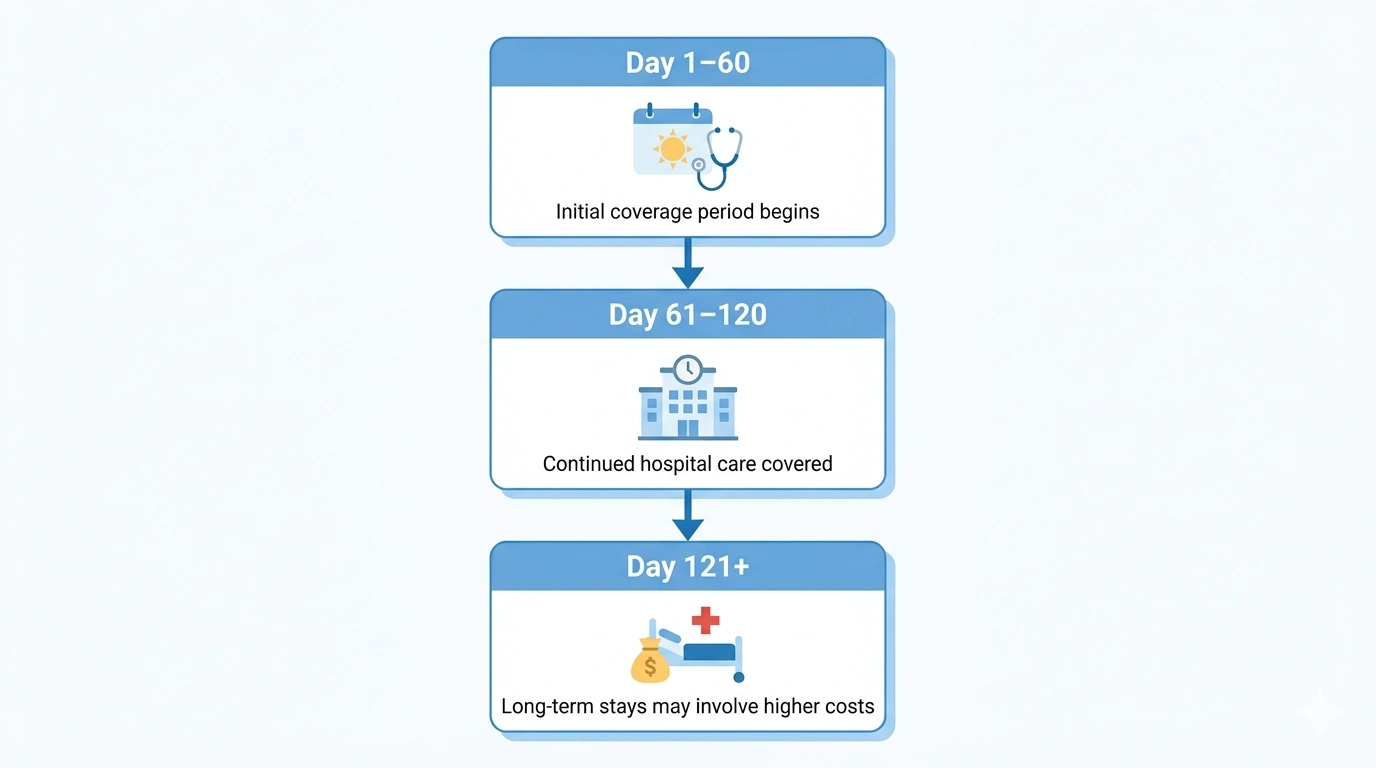
Medicare home health care is delivered in 60-day benefit periods. There’s no set limit on how many benefit periods you can receive. Coverage renews every 60 days as long as your doctor recertifies your need and you still meet all eligibility requirements.
This is where most people get confused. Medicare home health doesn’t work like a hospital stay with a countdown timer. It’s more like a rolling renewal every 60 days, your care is reviewed, and if the need is still there, coverage continues.
Each 60-day period is treated as one episode. The OASIS assessment (Outcome and Assessment Information Set) is a standardized tool your home health agency uses to document your needs, track your progress, and justify continued coverage to Medicare.
Here’s what can trigger a new benefit period:
- You were discharged and then needed care again after a break.
- Your doctor recertified your plan at the 60-day mark.
- Your condition changed and required a new plan of care.
There’s no magic number of days after which Medicare automatically stops. The question is always: Does the patient still need skilled care and still qualify as homebound?
Physician Certification and Face-to-Face Requirements
You have to have a doctor to verify you require home health care before you can get services. An in-person visit must take place within 90 days before or 30 days after the start of care. Without this documented meeting, the Medicare Administrative Contractor (MAC) can deny the whole claim.
This isn’t a formality, it’s a firm and fast Medicare rule. The face-to-face meeting must be conducted by your primary physician, a specialist involved in your care, or a nurse practitioner or physician assistant working in collaboration with a doctor.
During the visit, the doctor is to record:
Why you’re stuck at home
What services do you need?
That the home health care is medically essential
Then the plan of care is reviewed and changed every 60 days. Your doctor signs off, the agency submits the paperwork and coverage continues as long as all is well.
Factors That Affect Medicare Home Health Coverage Duration
Medicare continues covering home health care as long as you’re homebound, require skilled services, and your doctor recertifies your need every 60 days. The moment any of those conditions stops being met, coverage can end regardless of how long you’ve been receiving care.
Several things can change how long Medicare pays:
- Improvement in your condition. If you’re fully recovered, Medicare stops. But and this is important Medicare can’t stop coverage just because you’ve plateaued. The 2013 Jimmo v. Sebelius settlement made clear that maintenance care still qualifies, even without improvement.
- Change in homebound status. If you start leaving home regularly and without difficulty, your eligibility may end.
- Failure to recertify. If your doctor doesn’t review and sign off on your care plan at the 60-day mark, coverage stops.
- Non-compliant care agency. If your agency loses its Medicare-certified status, you lose coverage.
Families often feel blindsided when coverage ends. The best protection is staying in close communication with both your doctor and your home health agency throughout the process.
How Much Does Medicare Home Health Care Cost You?
Medicare covers approved home health services at no cost to you, no copay, no coinsurance, and no deductible for the services themselves. The one exception is durable medical equipment (DME), for which Medicare pays 80% and you’re responsible for the remaining 20%.
Under Medicare Part A and Medicare Part B, you pay $0 for:
- Skilled nursing visits
- Physical, occupational, and speech therapy
- Home health aide services (when tied to skilled care)
- Medical social services
You pay 20% coinsurance for:
- Wheelchairs, walkers, hospital beds, and other durable medical equipment
If you have a Medicare Supplement (Medigap) plan, it may cover that 20% DME cost. Medicare Advantage (Part C) plans follow different rules coverage and costs vary by plan, so always verify with your insurer directly.
Real-Life Scenarios: How Long Did Medicare Pay?
This is the part both competitor articles skip entirely and it’s what people actually need to understand.
After a hip replacement surgery:
A 72-year-old recovers at home with skilled physical therapy and nursing visits. After 6 weeks (one benefit period), she’s mobile and no longer qualifies as homebound. Medicare coverage ends. Duration: 60 days.
After a stroke:
A 68-year-old man has significant mobility and speech impairments. He needs physical therapy, occupational therapy, and speech therapy for months. His doctor recertifies every 60 days. Coverage runs for 8 months across four benefit periods.
For a chronic condition like COPD:
A patient manages a complex breathing condition at home with regular skilled nursing visits for medication management and monitoring. As long as she remains homebound and care is medically necessary, coverage continues indefinitely sometimes years.
The duration isn’t arbitrary. It follows the patient’s condition.
What Happens When Medicare Home Health Coverage Ends?
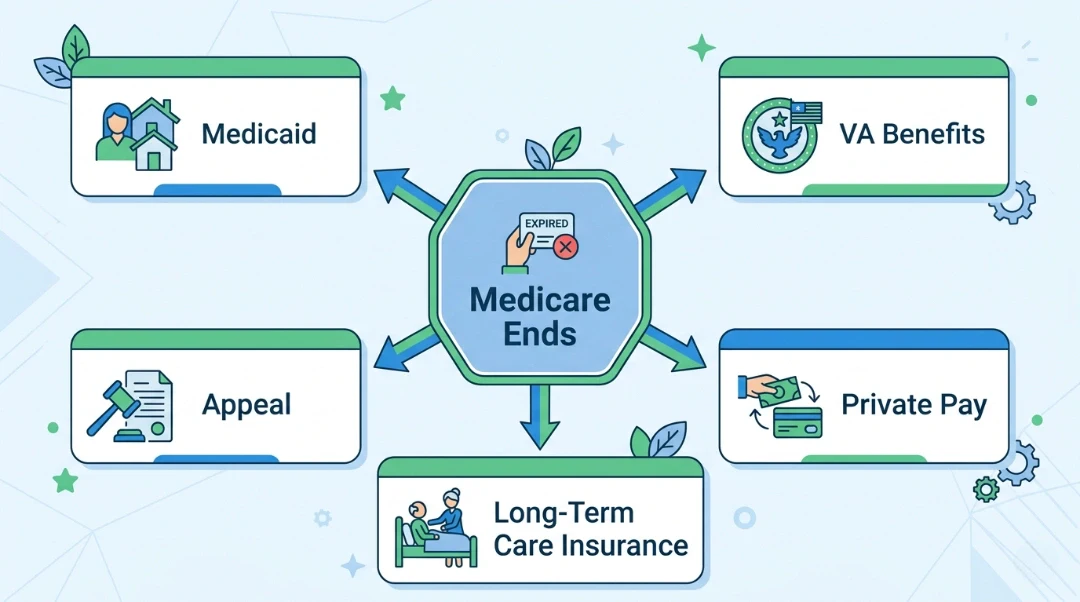
When Medicare stops paying for home health care, you have several options: appeal the decision, transition to Medicaid if you qualify, explore long-term care insurance, access VA benefits if you’re a veteran, or arrange private-pay services.
Here’s your roadmap:
- Appeal the Decision If you believe coverage was cut prematurely, you have the right to appeal. Contact your Medicare Administrative Contractor (MAC) within 60 days of receiving a denial notice. Submit written documentation from your doctor. If denied again, you can request a hearing before an Administrative Law Judge (ALJ), escalate to the Medicare Appeals Council, and ultimately pursue federal court review.
- Medicaid If your income and assets fall within your state’s guidelines, Medicaid may cover home health services often more broadly than Medicare. Eligibility varies significantly by state.
- Long-Term Care Insurance If you purchased a policy before the need arose, it may cover extended home care. Review your policy closely for benefit triggers and daily limits.
- VA Benefits Veterans may qualify for home health services through the Department of Veterans Affairs. This is an underused benefit worth exploring.
- Private Pay Some families pay out of pocket for home care services, especially for custodial or personal care not covered by Medicare. Sliding-scale fees and payment plans are available through many agencies.
If you’re in the Denver area and looking for trusted support after Medicare coverage ends, Castle Pines Home Care offers personalized home care services in Denver designed to fill exactly these gaps. Their team understands the transition from Medicare-covered care and can help you build a plan that doesn’t leave your family scrambling.
Frequently Asked Questions
Does Medicare pay 100% for home health care?
Yes for covered skilled services, Medicare pays 100% with no cost-sharing. The only exception is durable medical equipment, where you pay 20% coinsurance.
How long does Medicare pay for home health care after a hospital stay?
There’s no set number of days tied to a hospital stay. What matters is that you qualify as homebound and need skilled care. Coverage is available in 60-day periods for as long as those conditions are met.
Will Medicare pay for a home health aide?
Yes, Medicare will pay for a home health aide but only when you’re also receiving skilled nursing or therapy services. Medicare won’t pay for aide-only personal care.
Does Medicare cover in-home help for seniors who just need daily assistance?
No. Medicare does not cover custodial or personal care alone, such as help with bathing, dressing, or meal preparation, unless it’s part of a larger skilled care plan.
Who is eligible for home health care under Medicare?
Anyone enrolled in Medicare Part A or Part B who is homebound, has a physician’s order for skilled care, and receives services from a Medicare-certified agency.
Can Medicare home health care be permanent?
Technically yes if the need never goes away, coverage can continue indefinitely. But it requires ongoing recertification every 60 days and continuous homebound status.