

For most families getting a parent to a dialysis appointment is like putting a puzzle together – it shouldn’t be. Medical Transportation Cost Per Hour The quick answer: $25-$100 for ambulatory $45-$150 for wheelchair accessible vehicle $75-$250+ for stretcher transport That said, most carriers don’t actually charge you per the minute. They have a base fare + per mile fare and the “hourly” number only comes into play in certain circumstances like as wait time or standby service.
This article breaks down the statistics for the vehicle type, the distance and time of day, and the lesser expenses that tend to show up on your final bill without warning. We’ll also discuss what insurance really covers and how to save money while keeping safety in mind. By the end, you’ll be able to ask a provider the right questions before you schedule a ride.
Medical Transport Cost Overview
Calculating non-emergency medical transportation (NEMT) expenses can feel confusing because companies mix hourly standby charges with mileage fees. If a driver picks you up, takes you to a clinic, and leaves, you pay a flat base fee plus a mileage rate. If you hire that same driver to stay parked outside during your two-hour procedure, an hourly wait fee kicks in.
Understanding this distinction helps you avoid paying for unnecessary driver downtime. Private-pay rides generally follow this two-tier billing system. The table below breaks down typical national pricing structures across common service arrangements.
| Billing Structure | Average Price Range | Best Used For |
| Hourly Wait / Standby Fee | $25 – $100 per hour | Short multi-stop errands, unpredictable doctor appointments |
| One-Way Base Load Fee | $25 – $250 flat fee | Point-to-point single trips |
| Per-Mile Rate | $3.00 – $10.00 per mile | Long-distance or interstate travel |
Is Medical Transport Priced Per Hour or Per Mile?
Most medical transport providers charge per journey, not per hour. Typically you pay a base fare plus a mileage fare, and you are billed by the hour when the driver is waiting, on standby service or driving you on long routes with several stops. It is unusual to see flat hourly charges, except for longer standby bookings for events or hospital discharge holds.
Generally you’ll see an invoice that looks like this: base rate + (miles x mileage rate) + applicable surcharges. Hourly rates are most common in three circumstances: 1) The driver gets to your appointment and has to wait past a grace period, 2) A company has a vehicle on standby for a facility, or 3) A client books a predetermined block of time for multiple visits in one trip, i.e. a drugstore run, then a doctor’s appointment.
If you’re comparing hourly quotes to per-trip quotes from multiple firms, ask each company to break down the figure the same way. That flat $60 rate may sound less than a $25 base plus $3 a mile ride, until you realise that the second one is a 20 minute cross town ride for less money total.
Average Medical Transportation Cost by Service Type

The type of ride you need is the single biggest factor in your final cost. Here’s how the three main service levels typically compare on a short, in-town trip.
| Service Type | Base Rate | Per-Mile Rate | Approx. Hourly Equivalent |
| Ambulatory (sedan/SUV) | $15 – $65 | $2 – $4 | $25 – $60 |
| Wheelchair (ADA van) | $45 – $115 | $3 – $6 | $45 – $100 |
| Stretcher (ambulette) | $100 – $525 | $5 – $16 | $75 – $250+ |
Ambulatory transport is the right fit for a patient who can walk to the vehicle and sit upright for the ride. Wheelchair transport uses a van with a ramp or lift and a securement system, which explains the jump in price. Stretcher transport needs a two-person, often CPR-certified crew and medical equipment on board, which is why it costs several times more than the other two.
What Factors Affect Medical Transport Costs?
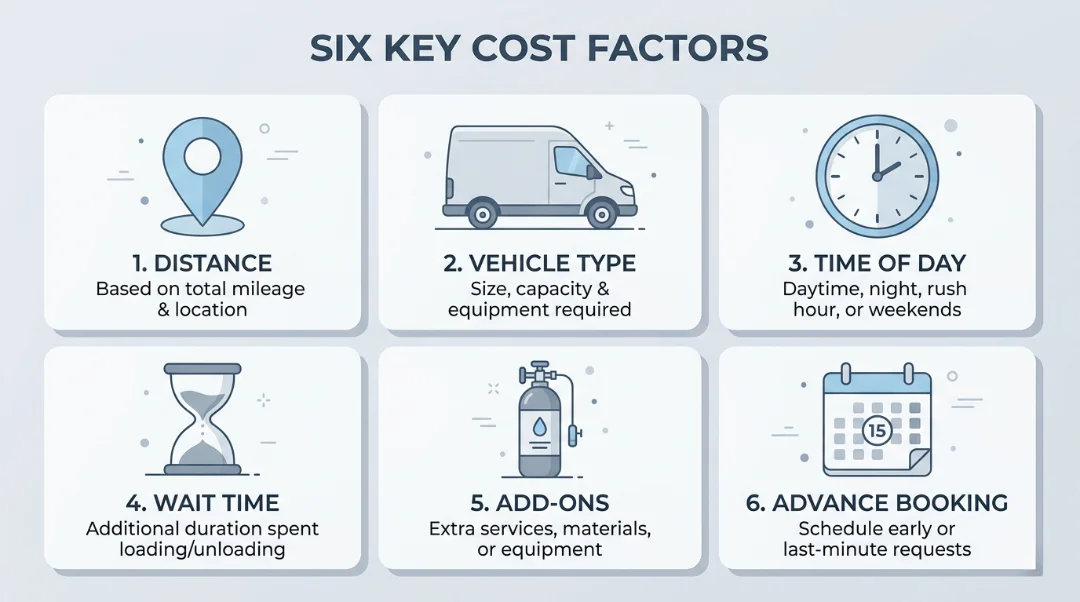
Medical transport costs are shaped by trip distance, equipment needs, booking schedules, weight requirements, and insurance authorization limits. Understanding these variables helps you accurately project your total out-of-pocket expenses.
While base rates set the starting line, secondary factors often dictate your final bill.
Distance and Route Geography
Total mileage remains a chief driver of overall trip expenses. While short trips rely heavily on base fees, long-distance inter-city travels accrue substantial per-mile charges. Crossing state lines or taking toll roads can also generate extra administrative costs.
Wait-Time Duration and Grace Periods
If you ask a driver to wait while you visit a doctor, standby fees apply. Most providers offer a brief 10 to 15-minute grace period at pickup. After that window closes, wait time is billed in 15 or 30-minute increments, adding up to $25 to $100 per hour.
Weekend, Evening, and Holiday Surcharges
Scheduling rides outside standard business hours triggers extra charges. Evening, weekend, or major holiday bookings often incur a 1.5x to 2.25x markup on the base rate to cover driver overtime.
Medical Equipment and Assistance Add-Ons
Additional care equipment carries standardized flat surcharges. Common add-ons include:
- Supplemental Oxygen: $25 – $40 flat fee per trip
- Stair-Chair Assistance: $25 – $50 for carrying passengers up or down steps
- Extra Attendant: $10 – $30 per hour for dedicated companion support
Bariatric Support Requirements
Passengers weighing over 250 to 300 pounds often require heavy-duty bariatric wheelchairs or stretchers. These specialized setups need wider ramps, reinforced lift mechanisms, and a mandatory two-person assistance team, adding $50 to $100 to the standard load fee.
Medical Transport Cost by Vehicle Type
The vehicle a patient needs is the clearest predictor of price, so it’s worth understanding each option in more depth.
Ambulatory transport works for patients who can walk short distances and sit upright for the whole ride. It’s the least expensive option since it only requires a standard vehicle and one driver.
Wheelchair transport uses a van fitted with a ramp or hydraulic lift, along with a securement system to hold the wheelchair steady during the drive. The base cost sits higher than ambulatory transport because of the specialized vehicle and setup time at each stop.
Stretcher transport, sometimes called ambulette service, is built for patients who must stay lying down. It requires a two-person crew, a hydraulic stretcher, and equipment for oxygen or basic monitoring. This is the highest-cost tier by a wide margin, often three to five times the ambulatory rate for the same distance.
Bariatric transport is a smaller category worth mentioning. Patients over roughly 250 to 300 pounds may need reinforced equipment and additional staff, which usually adds its own surcharge on top of the wheelchair or stretcher rate.
Medical Transport vs Other Transportation Options
Often, families see non-emergency medical transport as a middle ground between two other options: a rideshare app or a full emergency ambulance. Each is appropriate for a distinct situation and choosing the wrong one can be much more expensive than it should be or even worse endanger a patient.
A ridesharing service is perfect for a patient who is totally ambulatory, doesn’t need any equipment, and can independently get in/out of a conventional car. On paper it’s the cheapest choice, but the drivers have no medical expertise and most regular vehicles can’t fit a wheelchair or stretcher at all.
An emergency ambulance is made for a different purpose. It is designed for when a patient’s condition can turn for the worse quickly during transport and it is significantly more expensive, sometimes thousands of dollars for just one journey. Non-emergency medical transport sits right in the middle. It’s meant for people who are medically stable, but still require a wheelchair van, a stretcher or simple hands-on assistance going from one spot to another, for a fraction of an ambulance’s cost.
Insurance and Payment Options for Medical Transport
Coverage for medical transport varies more than most people assume going in, so it pays to check before you book. Medicaid is the most reliable payer for NEMT in most states, covering rides to and from medically necessary appointments, though prior authorization is usually required and can take one to two weeks to process.
Traditional Medicare rarely covers non-emergency rides. It’s built around emergency ambulance transport that meets strict medical necessity rules, not routine trips to a specialist or a follow-up visit. Some Medicare Advantage plans include a limited NEMT benefit as a supplemental perk, so it’s worth a call to your plan directly to ask what’s included.
Private health insurance plans mostly leave NEMT out of standard coverage too, though a small number include it for specific conditions or post-surgical recovery. Workers’ compensation can cover transport tied to a work injury, arranged through the employer’s insurance adjuster. For everyone else, private pay remains the most common route, and it comes with the benefit of skipping the authorization wait entirely.
How to Reduce Medical Transport Costs
You can significantly lower medical transport expenses by booking two one-way rides, scheduling weekday appointments, leveraging insurance benefits, and comparing local quotes. Strategic planning keeps safe, dependable transportation within reach.
Example Calculation: $135 in wait time fees saved by booking two $45 one-way wheelchair trips.
When you need regular rides, small adjustments in booking habits yield meaningful savings over time.
- Book Split One-Way Trips Instead of Wait Time: If a doctor’s appointment lasts longer than two hours, avoid paying $45 to $100 per hour in standby fees. Schedule two separate one-way rides instead.
- Schedule Appointments During Off-Peak Hours: Aim for mid-day, mid-week appointments. Booking between Tuesday and Thursday helps you skip weekend multipliers and rush-hour delays.
- Verify Medicaid and Medicare Advantage Coverage: Medicaid often covers non-emergency transportation at little to no cost for eligible individuals. Additionally, many Medicare Advantage (Part C) plans offer transportation credits for medical visits.
- Request Standing Order Discounts: If you need routine transportation for ongoing treatments like dialysis or chemotherapy, ask providers for recurring route discounts.
- Plan Ahead to Avoid Rush Booking Fees: Booking 48 to 72 hours in advance protects you from last-minute dispatch surcharges.
How to Choose a Provider
The right provider is licensed, insured, and upfront about pricing before you book, not after the ride is finished. Look for a company that explains its base rate, mileage charge, and any surcharges in plain terms, and that has real reviews from patients or families in your area.
A few questions are worth asking any company before you commit. Are drivers trained for the specific vehicle type you need? Is the vehicle inspected regularly, and is the crew certified for basic first aid or CPR? Does the quote include tolls, wait time, and fuel, or will those show up as separate charges later?
If you’re weighing your options in the Denver metro area and looking into home care services in Denver that go beyond a single ride, it helps to work with a provider who treats transportation as one part of a bigger support plan rather than a one-off service. Castle Pines Home Care builds that kind of plan around the whole person, not just the trip in front of you, with pricing explained clearly before anyone gets in the vehicle.
Final Thoughts
Ensuring your loved one maintains their freedom and attends critical medical appointments doesn’t have to be a source of constant stress for your family. By partnering with dedicated professional caregivers who offer tailored assistance and reliable Senior Transportation in Denver, you can rest easy knowing they are receiving safe, compassionate support every step of the way. Contact Castle Pines Home Care today to learn how our personalized care plans can empower your loved one to live comfortably and independently at home.
Frequently Asked Questions
What is the average cost of medical transport per hour?
Most non-emergency rides fall between $25 and $150 an hour depending on vehicle type, though providers typically bill per trip rather than per hour.
Does Medicare cover non-emergency medical transportation?
Traditional Medicare generally doesn’t cover it. Some Medicare Advantage plans include a limited benefit, so it’s worth confirming directly with your plan.
How much does wheelchair transportation cost?
Wheelchair-accessible van service typically runs $45 to $150 per trip in most markets, depending on distance and the time of day booked.
Is medical transport cheaper than calling an ambulance?
Yes. Non-emergency transport is built for stable patients and costs a fraction of an emergency ambulance ride, which can run into the thousands of dollars.
Can I get free or low-cost medical transportation?
Medicaid covers NEMT for eligible patients in most states, and some nonprofit groups fund transport for people with specific medical conditions. A hospital social worker is a good starting point for finding local programs.
How far in advance should I book medical transport?
Booking 48 to 72 hours ahead usually gets you the best rate and the widest choice of available time slots, especially for wheelchair or stretcher service.