

You’ve seen something new about your mom or dad lately. Maybe some bill was not paid, maybe they seemed wobbly walking to the mail box. You’re not crazy. You’re not alone. Almost every family reaches a point where the parent who once handled everything needs a hand themselves.
The 40/70 rule for aging parents is a guideline that suggests families should start talking about health, money, and future care after adult children age 40 or a parent turns 70, whichever happens first. It’s a timing hint, not a legal requirement, aimed to open honest conversations before a crisis compels fast judgments.
What the 40/70 Rule Actually Means
The 40/70 rule isn’t a medical standard or a piece of legislation. It’s a rule of thumb that grew out of caregiver support groups and geriatric care management circles, meant to give families a simple trigger point instead of waiting for a fall or a hospital stay to force the issue.
At its heart, the 40/70 rule for elderly parents is about timing, not paperwork. It states the optimal window to start planning is early, while your parent can still speak for themselves and while you have the bandwidth to help without it feeling like an emergency. If you wait until a health scare hits, decisions will be made under pressure, with fewer information and with more stress on all involved.
Here too we see a role reversal. The parent who once ran the house now needs help running it and that transition might be unpleasant for both of them. Quite simply, talking it out, rather than not talking it out, tends to smooth the whole process down.
Why Age 40 and 70 Specifically?
Age 40 tends to be when adult children have steadier careers, established households, and more capacity to help without upending their own lives. Age 70 is roughly when health risks start climbing for many people. Pairing these two ages gives families a natural checkpoint before small issues turn into emergencies.
Neither number is magic. Some families need to start these talks at 35 because a parent has an early diagnosis. Others wait until closer to 75 because a parent is still sharp, active, and fully independent. The 40/70 rule works best as a reminder to check in, not a countdown clock.
What does change around 70 is risk. Falls become more common, chronic conditions like heart disease and diabetes become more likely, and cognitive changes can appear gradually rather than all at once. A strong data point here would be CDC statistics on fall rates or chronic disease prevalence among adults 65 and older, cited directly from cdc.gov, so readers see this isn’t guesswork.
5 Warning Signs It’s Time to Have “The Talk”
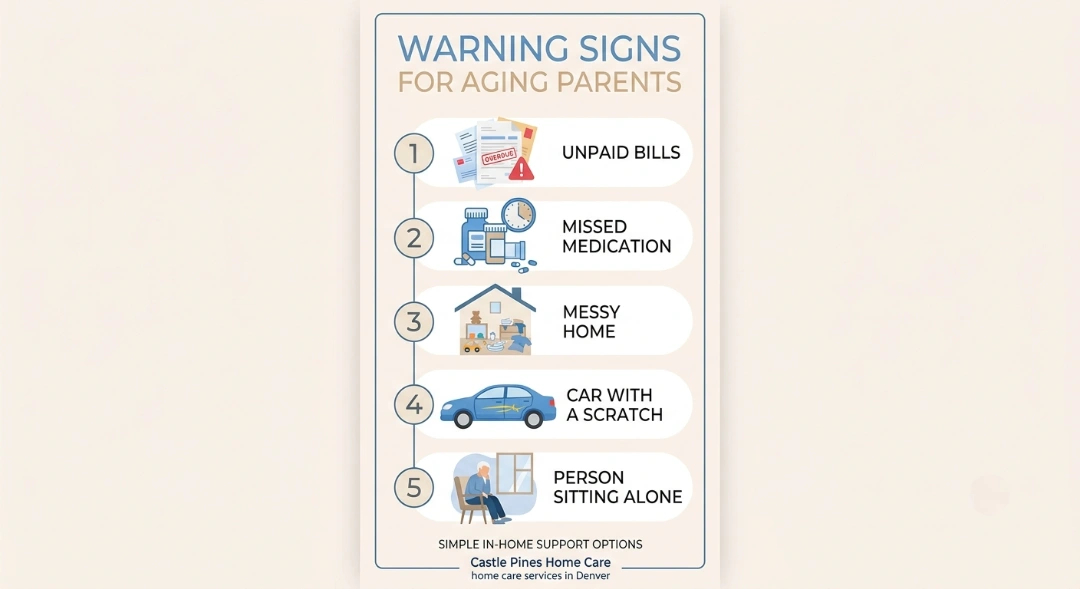
The key signs it is time for a conversation include noticeable weight loss, uncharacteristic household clutter, unpaid bills, missed medications, and minor driving accidents. These early indicators show that routine daily tasks are becoming challenging, even if your parent insists everything is fine.
Sometimes, life does not wait until you hit exact numerical milestones. If you spot these early red flags, you should start talking regardless of your current ages:
- Changes in Household Management: Piles of unopened mail, late payment notices, or an unusually messy kitchen in a home that was previously kept spotless.
- Physical or Personal Hygiene Changes: Wearing the same clothes for days, skipping showers, unexplainable bruises from unmentioned trips or stumbles, or sudden weight loss.
- Medication Confusion: Prescriptions filled but left untouched, pill bottles mixed up, or missed doses.
- Driving Concerns: Fresh scrapes on the car, getting lost on familiar routes, or sudden anxiety about driving at night.
- Social Withdrawal and Mood Shifts: Canceling regular social outings, losing interest in long-standing hobbies, or showing subtle memory gaps.
Spotting these signs does not mean your parent needs to move out of their home tomorrow. It simply signals that the buffer zone is shrinking, making “the talk” an immediate priority.
How to Start the Conversation With Your Parents
Start the conversation by sharing your own life planning, asking open-ended questions, and keeping the focus on preserving their independence and choices. Avoid heavy, formal family summits that feel overwhelming or aggressive to an aging parent.
Bringing up topics like money, health, and driving can feel uncomfortable. Parents fear losing their freedom, while adult children worry about coming across as bossy or invasive. To keep the conversation constructive, focus on preserving their autonomy and keeping them in charge.
Use “Blame the Paperwork” Strategies
Instead of focusing on their age, bring up your own estate planning or news events. You can say:
“I’ve been working on my own will and medical directive lately, and it made me realize I don’t actually know what your preferences would be if you ever faced a medical emergency. What would you want me to know so I don’t have to guess?”
Ask About Their Friends
Peer experiences offer a gentle doorway into sensitive topics. Try asking:
“I know your neighbor recently had a bad fall and needed help at home. Did that make you think about what kind of support you’d want if you ever ran into a physical setback?”
The Essential Aging Parent Checklist
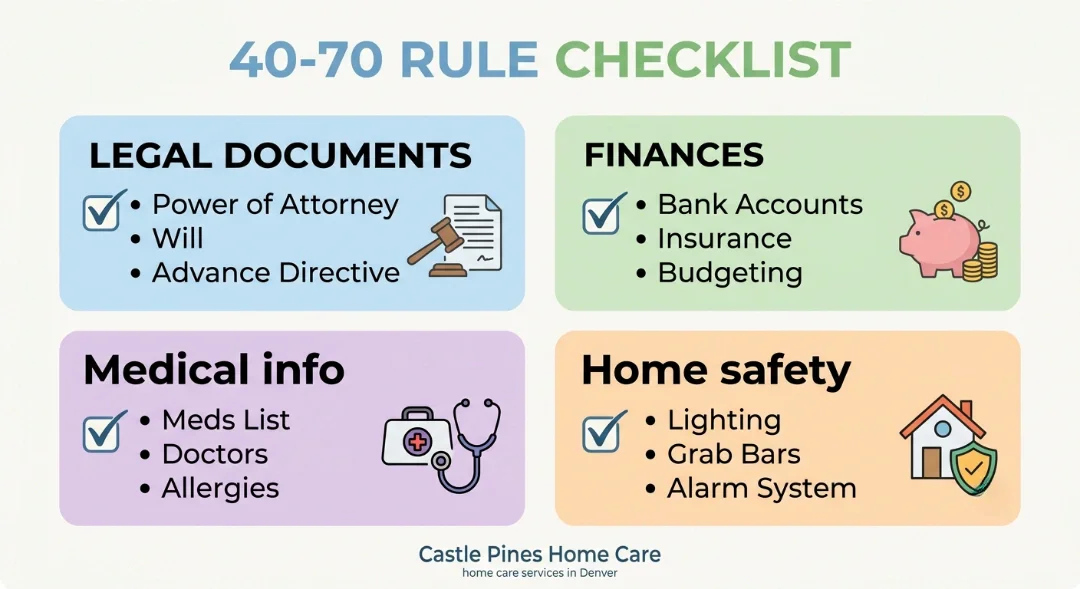
An aging parents checklist gives you a clear starting point instead of a vague sense that “something should be done.” You don’t need to finish it all at once. Pick one section, gather what you can, and build from there.
Think of this less like a form to complete in one sitting and more like a folder you keep adding to over a few months. Some families tackle the legal section first because it feels most urgent. Others start with the medical file since it’s easier to talk about doctors than money. Either approach works, as long as you keep moving forward.
Legal documents to track down:
- Durable power of attorney for parents, covering both finances and medical decisions
- A living will or advance directive
- HIPAA authorization so you can legally speak with doctors
- Will or trust paperwork
Financial planning for elderly parents:
- Bank accounts, retirement accounts, and Social Security details
- Insurance policies, including long-term care coverage if it exists
- Mortgage, property tax, and recurring bill information
- Contact details for a financial advisor or accountant
Medical and daily living information:
- Current diagnoses, medications, and allergies
- Primary doctor and specialist contact information
- A note on what tasks feel harder lately, like cooking, bathing, or getting dressed
Home and social check:
- A quick walk-through for fall risks like loose rugs or poor lighting
- A look at how often your parent sees friends or leaves the house
What to Cover Once the Conversation Starts
Usually the legal elements take the most attention first, when your parent is ready to talk. A durable power of attorney for parents allows a trusted individual to step in for financial or medical decisions if your parent ever can’t manage those things alone. Without one, families are often faced with a court process simply to get the most basic authority to help.
This is when it’s good to get an elder law attorney involved vs. trying to do it all with online templates. Rules governing these documents vary from state to state, and a small mistake can make a document unenforceable when you need it most. Think of it as creating an elder care planning guide that is unique to your family, not a generic form.
Aging parent financial planning is more than where’s the money. It’s a way to keep tabs on whether bills are being paid on time and whether spending habits have altered. A good data point here would be information from the Consumer Financial Protection Bureau on elder financial exploitation rates, as that background explains why account monitoring is important, not just record keeping.
How Often Should You Revisit These Conversations?
Review your parent’s plan every six to twelve months, or sooner after any major change such as a fall, a new diagnosis, a hospital stay, or the loss of a spouse. Aging isn’t a fixed condition, so a plan that worked last year might not fit anymore.
This is where the difference between crisis planning and proactive planning really shows up. Crisis planning means scrambling for documents in a hospital waiting room. Proactive planning means those documents already exist, and the update is just a quick check-in over coffee.
Set a specific reminder, maybe tied to a holiday visit or a birthday, so this doesn’t quietly slip off everyone’s radar.
Getting Support When Family Care Isn’t Enough
Even with a solid plan, there comes a point where family alone can’t cover everything, and that’s not a failure on your part. It’s simply a sign the situation has changed. Bringing in outside, non-clinical support can protect your parent’s independence at home while giving you room to breathe.
This is where home care services in Denver can fill the gap, whether that means a few hours of help with meals and light housekeeping or more regular support with daily routines. At Castle Pines Home Care, we work with families who are exactly at this stage, trying to balance real jobs, their own households, and a parent who needs more support than they expected.
Final Thoughts
The 40/70 rule for aging parents isn’t about ticking off a checklist by a certain birthday. It’s a reminder to start talking before a crisis makes the decision for you. Small, early conversations almost always beat rushed ones made in a hospital hallway.
If your family is at this stage and could use extra hands, contact us at Castle Pines Home Care to talk through what support might look like for your parent.
Frequently Asked Questions
Is the 40/70 rule an official medical guideline?
No, the 40/70 rule isn’t a medical or legal standard. It’s an informal guideline used by caregiver support groups and elder care professionals to help families pick a reasonable starting point for planning conversations, based on typical life stages rather than a specific diagnosis or test.
Think of it as a nudge rather than a rulebook. Your family’s actual timeline should follow your parent’s health and independence, not a birthday.
What documents should I gather first?
Start with a durable power of attorney for both finances and health care, along with a living will or advance directive. These two documents give a trusted person legal authority to step in if your parent ever can’t make decisions on their own, which matters more than any other paperwork on the list.
Everything else, like insurance details and account information, can follow once those core documents are signed and stored somewhere accessible.
Does Medicare pay for in-home care?
Medicare generally doesn’t cover ongoing non-medical home care, such as help with bathing, cooking, or housekeeping. It may cover short-term skilled care after a hospital stay under specific conditions, so most families rely on private pay, long-term care insurance, or Medicaid for ongoing support.
Check your parent’s specific plan directly, since coverage details can change and vary by state and provider.
How do I talk to a parent who refuses any help?
Refusal is common and usually comes from a fear of losing independence, not stubbornness for its own sake. Framing help as a way to protect their independence, rather than replace it, tends to work better than pushing facts or statistics at them.
Give it time, bring up one small change at a time, and consider asking a doctor to reinforce the suggestion. Sometimes advice lands differently coming from someone outside the family.
What’s the difference between the 40/70 rule and general elder care planning?
The 40/70 rule is simply about timing, telling you when to start the conversation. Elder care planning is the actual work that follows, covering legal documents, finances, medical coordination, and living arrangements once that first conversation has happened.