
It can be hard to find the right kind of support system for an aging loved one. When it comes to making big decisions, precise information is needed on how to balance personal independence, daily care needs and family budgets.
Understanding what are the different levels of senior care can help families evaluate expected monthly prices, find suitable support options and make informed decisions. Senior care exists on a continuous continuum from basic home support to specialized medical supervision.
How Are Senior Care Levels Defined?
The level of senior care is based on how much help a person requires with activities of daily living, not on age or diagnosis alone. Providers measure this through tasks such as washing, dressing and eating (Activities of Daily Living or ADLs), and handling money or medication (Instrumental Activities of Daily Living or IADLs). The more help a person needs with these activities, the greater their care level is.
This is important, because two 82 year olds can need very different things. Might need a reminder to take her blood pressure medicine. She could need a physical somebody to get her out of bed. They are both “seniors needing care,” but the amount of care for the old is nothing alike.
Communities and agencies rely on formal tools to mitigate the subjectivity. The Katz Index rates independence in six basic activities. The Barthel ADL Index includes grooming and stair climbing. The Functional Independence Measure (FIM) adds a scoring system for physical and cognitive limitations in 18 categories. None are flawless, but they provide families and workers a common language, not a guess.
The Senior Care Continuum, Explained
The senior care continuum structure allows individuals to receive appropriate physical support while maintaining personal autonomy. Aging in place through supportive services often serves as an initial step before residential placement becomes necessary.
Understanding how care levels function ensures families select services that align with current functional needs rather than paying for unnecessary levels of care.
Key Distinction: Non-clinical personal care assists with everyday physical routines (ADLs/IADLs). Skilled healthcare provides licensed medical interventions like wound management, physical therapy, and intravenous treatment
The 6 Levels of Senior Care
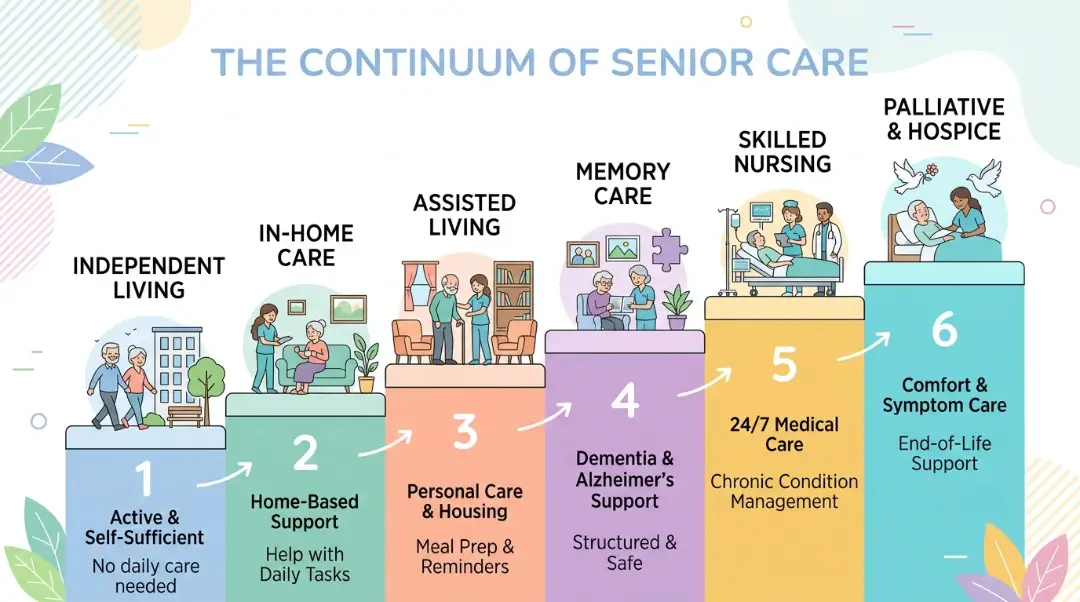
Here’s where things get specific. Below are the six stages most families encounter, listed from least to most intensive.
Independent Living
Independent living is for seniors who don’t need daily assistance but want less home upkeep and more social connection. No caregivers are involved in daily tasks here. Residents simply trade lawn care and cooking for a maintenance-free apartment and a built-in social calendar.
This option works well for someone who’s still driving, cooking, and managing their own schedule but is tired of maintaining a big house alone.
In-Home Care
In-home care brings help directly into someone’s house instead of moving them into a facility. This might mean a few hours a week of housekeeping, or daily visits for medication reminders and companionship. It’s often the first formal support a family adds, usually starting small and growing as needs change.
For many families, this is the most affordable and least disruptive first step. It lets a parent stay in a familiar home while getting just enough support to stay safe.
Basic Assisted Living
Basic assisted living (sometimes called low-care or Level 1) provides light help with daily tasks while the resident remains mostly independent. Staff handles medication reminders, occasional help with dressing and light supervision. Residents at this level don’t yet need hands-on assistance, just a bit of structure and a safety net nearby. This is one of the more common levels of assisted living, and it’s where a lot of families start once in-home care isn’t quite enough anymore.
Intermediate Assisted Living
Intermediate assisted living, or Level 2, kicks in when a resident needs hands-on help with at least one ADL, such as bathing or dressing. Staff also start coordinating more closely with outside doctors and therapists at this stage. It’s a middle ground: more support than basic care, but still far from a nursing facility.
Some communities break this into additional sub-levels, which is part of why you’ll see references to a 5 levels of care in assisted living model at certain facilities.
Advanced Assisted Living
Advanced assisted living, sometimes labeled Level 3 or “personal care,” is for residents who need help with most or all of their ADLs. This usually involves more than one caregiver for tasks like transferring in and out of bed. Health monitoring becomes more frequent, and care plans get reviewed more often.
At this stage, families are often having serious conversations about whether assisted living levels of care still meet their loved one’s needs, or whether it’s time to look at memory care or skilled nursing instead.
Memory Care and Skilled Nursing
Memory care is built specifically for residents with Alzheimer’s or other forms of dementia, using secured layouts and staff trained in cognitive decline. Skilled nursing, the highest tier, provides 24-hour licensed medical care for serious conditions, post-surgical recovery, or long-term chronic illness. Many campuses offer both side by side, so a resident can shift between them without changing addresses entirely.
How Is a Senior’s Level of Care Determined?
The level of care for a senior is established through a thorough assessment that measures ADLs, IADLs, mobility and cognitive function, usually by a nurse or care coordinator. “This is not a five minute talk. It’s a systematic assessment, generally repeated when someone enters a community, following a health event, and then routinely every six months or so.
The examination is more than just physical strength. They watch how a person gets out of a chair, if they can pick up a pen and how they react to simple everyday requests. Family members are often startled either way: sometimes a parent needs more help than anyone thought, and occasionally they are doing better than the family gave them credit for.
If you ever wonder how the level of care is determined in a certain community, ask to sit in on part of the assessment. Most places allow it and if you see it in person it is better than any brochure can tell you.
Cost Comparison by Level of Care
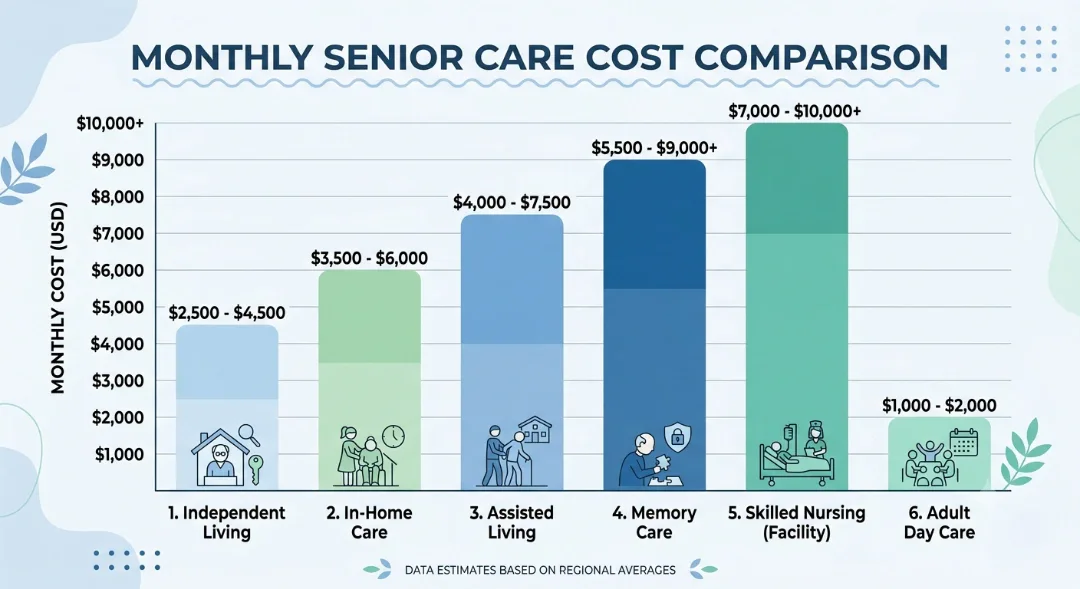
Care costs depend on direct support hours, facility amenities, geographic region, and required clinical oversight. Understanding what are the different levels of senior care financially helps families organize long-term care plans.
| Level of Care | Primary Support Provided | National Monthly Median Cost (US) | Typical Payment Sources |
| Independent Living | Housing, meals, maintenance | $3,000 – $4,500 | Private pay, retirement savings |
| In-Home Support (Non-Medical) | Assistance with ADLs & IADLs | $30 – $38 per hour | Private pay, long-term care insurance, Medicaid waivers |
| Assisted Living (Base) | Housing, meals, light care | $5,200 – $6,200 | Private pay, VA benefits, long-term care insurance |
| Assisted Living Add-On Tier | High-care ADL support | +$600 – $2,700 additional | Private pay, long-term care insurance |
| Memory Care | 24/7 dementia support & security | $6,500 – $7,500 | Private pay, long-term care insurance |
| Skilled Nursing Facility | Continuous clinical care | $9,200 – $10,800 | Medicare (short-term rehab), Medicaid (long-term), private pay |
Signs It’s Time to Move Up a Level of Care
Evaluating key behavioral and physical indicators helps families determine when current support structures need adjustment.
Common indicators include:
- Frequent Falls or Bruising: Difficulty standing up or navigating domestic spaces safely.
- Medication Mistakes: Forgetting daily doses, taking incorrect amounts, or losing track of prescriptions.
- Nutritional Decline: Unexplained weight loss, spoiled food remaining in refrigerators, or missed meals.
- Caregiver Burnout: Family members managing personal daily care experience physical fatigue, high stress, or chronic illness.
How State Regulations Affect Senior Care Levels
Senior living regulations vary across state lines because residential care facilities operate under state oversight rather than uniform federal agencies.
States define facility licenses, room size specifications, caregiver-to-resident staffing ratios, and medication administration rules differently:
- Terminology Variations: Some states classify assisted living sites as “personal care homes,” “residential care facilities,” or “assisted care communities.”
- Staffing Regulations: State laws determine whether non-licensed staff members can administer medications or if licensed practical nurses (LPNs) must oversee drug administration.
- Transfer Requirements: State rules establish strict safety boundaries regarding when an individual’s health needs exceed what an assisted living facility can legally handle, requiring a transfer to a skilled nursing center.
Finding the Right Level of Care Near You
Reading about levels of care for elderly loved ones only gets you so far. At some point, you need someone local who knows the actual facilities, their real reputations, and which ones handle transitions well. That’s true whether you’re comparing large communities or looking into home care services in Denver for a more gradual, in-home start.
At Castle Pines Home Care, this is the exact conversation we have with families every week. We help sort out what level of support actually matches a loved one’s daily reality, not just what a brochure promises.
Final Thoughts
Figuring out what are the different levels of senior care isn’t about picking the “right” answer on the first try. It’s about matching support to need, watching for changes, and adjusting as things shift. Most families move through this in stages, and that’s normal.
If you’re at the point where you need a clearer picture of your options, contact us and we’ll walk through it with you.
Frequently Asked Questions
What are the main differences between assisted living and skilled nursing?
Assisted living offers non-clinical personal care and apartment housing for individuals needing help with daily tasks. Skilled nursing facilities provide 24-hour licensed medical care and clinical rehabilitation for complex medical conditions.
Can an individual combine home care services with independent living?
Yes. Many independent living residents hire external non-medical home care agencies to assist with personal routines, hygiene, or medication management, extending their ability to stay independent.
How often are senior care assessments updated?
Care facilities and home care agencies typically re-evaluate functional needs every 6 to 12 months, or immediately following any significant change in physical health, mobility, or hospital stay.