

When you walk into a local clinic or see your doctor the first face you encounter after the front desk is a certain professional. They check your blood pressure and ask you why you are there and make sure the clinic is on time.
Knowing this clinical position gives you a greater opportunity to make good care options if you are seeking some economical strategies to keep an aging parent safe at home. Let’s take a closer look at what these specialists do so you can plan for the correct amount of help for your family.
What Is a Medical Assistant?
Medical assistants are trained health-care professionals who undertake a mixture of clinical and office responsibilities in doctors’ offices and clinics. They monitor your vital signs, maintain medical records and assist doctors in patient exams. Their support helps clinics run smoothly so doctors may focus on delivering medical treatment.
These experts are the link between the front lobby and the exam room. When you arrive at an outpatient treatment center, the first thing they do is the initial patient triage to know your immediate health state. They record basic health statistics, check the prescriptions you are currently taking and make sure the physician has all the information needed for your appointment.
We watch them doing vital background jobs that patients hardly perceive. They adhere to tight processes for updating Electronic Health Records (EHR) and safeguarding patient privacy under federal privacy regulations. They are hand-in-glove with medical staff but don’t diagnose ailments, administer prescriptions or give medical advice. Their major responsibility is to facilitate the procedure and prepare the patient within their legal scope.
A Day in the Life of a Medical Assistant
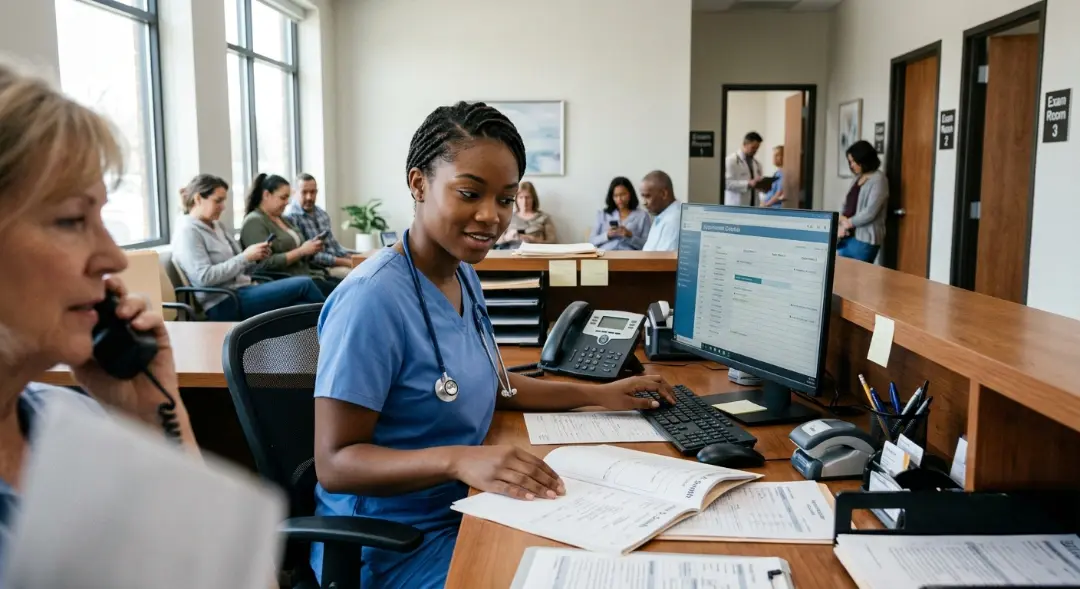
Picture a typical morning at a busy family practice. A medical assistant arrives early to pull charts and confirm the day’s schedule. Patients start arriving, and each one gets roomed: weight, blood pressure, temperature, a quick rundown of why they’re there today.
Between patients, there’s charting to finish, phone messages to return, and maybe a prior authorization form that insurance is holding up. A physician might ask for a quick EKG on a patient reporting chest tightness, or need help drawing blood for a lab order. By early afternoon, the same person handling that blood draw might be back at the front desk, checking in the next patient and answering a call about a prescription refill.
That back and forth between clinical and administrative work is what makes the job demanding but also varied. Few days look identical, and the pace rarely slows down during office hours.
Medical Assistant Duties: Administrative vs. Clinical
The daily medical assistant role splits into two distinct operational areas. Some professionals focus entirely on office management, while others handle direct patient preparation. Most workers in smaller practices manage a balanced combination of both throughout their shifts.
Administrative Responsibilities
Office operations require careful tracking to ensure proper patient tracking and steady clinic revenue. Workers handling these office systems manage patient check-ins, answer phones, and coordinate scheduling appointments to prevent long wait times in the lobby. They process new patient paperwork and enter detailed personal histories into the computer systems before the doctor steps into the room.
Handling insurance forms constitutes a major part of these daily business tasks. Workers must navigate complex medical billing and coding systems to ensure insurance companies process claims correctly. They file pre-authorization requests for procedures, organize referrals to outside specialists, and manage general clinic bookkeeping. Their attention to detail prevents billing errors that can cause frustrating delays for patients trying to access care.
Clinical Responsibilities
The clinical part of the work involves direct physical contact with patients and is done under direct medical supervision. Before the patient sees the doctor, the assistant takes vital signs such as blood pressure, pulse rate, temperature and weight. They keep accurate track of these stats since rapid changes can be a symptom of serious, underlying medical conditions.
They are trained to perform specific diagnostic tests as well as basic assessments. They do and read an EKG / ECG ( electrocardiogram ) to test for cardiac arrhythmias prior to routine physicals or procedures . They also take blood samples and other lab materials using venipuncture for diagnostic processing. After the major exam, they change wound dressings, take out surgical stitches and offer basic injections or immunizations as the doctor authorizes.
Medical Assistant vs. Other Healthcare Roles
How does this position differ from other clinic workers? It is easy to confuse different medical titles when you are trying to organize care for a family member. Knowing the differences in training and daily tasks helps you understand who is handling your loved one’s health needs.
| Healthcare Position | Average Training Time | Core Workplace Focus | Primary Workplace |
| Medical Assistant | 9 to 24 Months | Administrative work and basic clinical prep | Outpatient Clinics |
| Certified Nursing Assistant (CNA) | 4 to 12 Weeks | Hands-on personal care and daily living help | Nursing Homes & Hospitals |
| Licensed Practical Nurse (LPN) | 12 to 18 Months | Skilled nursing care and medication delivery | Hospitals & Extended Care |
| Registered Nurse (RN) | 2 to 4 Years | Advanced clinical care, case management, diagnostics | Hospitals & Specialized Units |
A Certified Nursing Assistant (CNA) focuses heavily on personal care like bathing, dressing, and moving patients who have limited mobility. They work mostly in nursing homes and assisted living buildings rather than medical offices. In contrast, an authorized medical attendant splits time between computer work and clinical prep in a standard office setting.
Nurses undergo far more rigorous clinical training and hold higher legal responsibilities. A Licensed Practical Nurse (LPN) or Registered Nurse (RN) can administer complex medications, start intravenous lines, and create detailed medical treatment plans. Medical assistants keep the office organized and prepare the patient, but they do not manage long-term medical treatments or make independent clinical decisions.
Where Do Medical Assistants Work?
Most medical assistants work in outpatient settings, such as physicians’ offices, specialized clinics, and urgent care facilities. Many also work in hospitals, dental offices, physical therapy clinics and nursing homes, wherever a physician requires support in administering everyday patient care and office operations.
Most medical assistants are in primary care and family medicine practices. “Most of the medical assistants are in primary care and family medicine because they have a high volume of patients and need help on the clinical side and the front desk side,” she said. Specialization clinics such as dermatology, cardiology or OB-GYN also require medical assistants that can do treatments particular to that specialization.
An increasing number of physician assistants are taking on virtual or hybrid duties, handling scheduling, patient intake forms and insurance verification remotely for telehealth businesses. This is a newer trend and is good to know if you care about flexibility. The clinical part of the work still has to be done face-to-face, but the administrative part is starting to go online in certain clinics.
How to Become a Medical Assistant
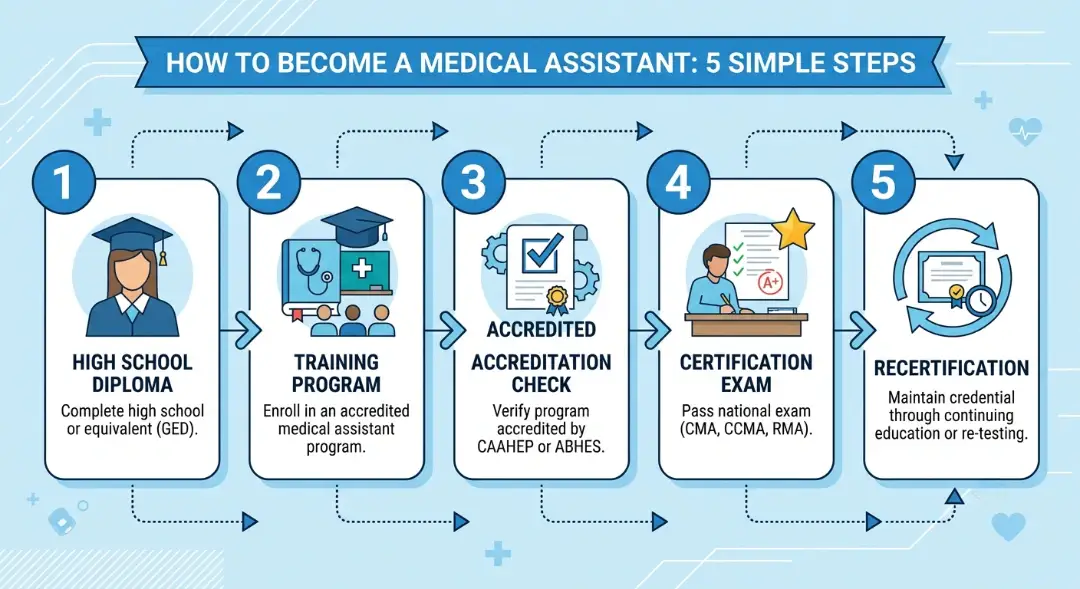
Most people follow a fairly clear path into this field, and it doesn’t require a four year degree.
Step 1: Finish high school or earn a GED. This is the baseline requirement for nearly every medical assistant program in the country.
Step 2: Complete a medical assistant training program. These programs run through community colleges, vocational schools, and career training centers. Most take between nine months and two years, depending on whether you’re earning a certificate, diploma, or associate degree. Coursework typically covers anatomy and physiology, medical terminology, pharmacology, and basic lab skills, along with an internship in a real clinical setting.
Step 3: Choose an accredited program. Programs accredited by the Commission on Accreditation of Allied Health Education Programs (CAAHEP) or the Accrediting Bureau of Health Education Schools (ABHES) meet a recognized quality standard and qualify you to sit for certification exams. Checking accreditation before enrolling saves you from wasted time and money later.
Step 4: Get certified. Certification isn’t legally required in most states, but most employers prefer it, and some clinical tasks require it depending on state law. The main certifying bodies include:
- Certified Medical Assistant (CMA) through the American Association of Medical Assistants
- Registered Medical Assistant (RMA) through American Medical Technologists
- Certified Clinical Medical Assistant (CCMA) or Certified Medical Administrative Assistant (CMAA) through the National Healthcareer Association
- National Certified Medical Assistant (NCMA) through the National Center for Competency Testing
Step 5: Recertify periodically. Most certifications require renewal every couple of years through continuing education or a repeat exam, so this isn’t a one time credential you earn and forget.
State rules on what a medical assistant role can legally include vary quite a bit. Some states require extra training before a medical assistant can give injections or handle certain medications. It’s worth checking your state’s specific scope of practice rules before assuming every duty listed here applies everywhere.
Skills Needed to Succeed as a Medical Assistant
The healthcare field needs a unique mix of technical skills and personal attributes. Assistants must be able to perform physical operations such as venipuncture, correct blood pressure readings and use of adequate sterilization techniques. They have to understand how to operate sophisticated computer medical databases and to work accurately without errors in the data entering.
Good personal communication skills are also important for everyday success in a busy clinic. Patients come in pain, puzzled about their insurance, or anxious. A good assistant needs patience, sensitivity and clear speaking habits to explain complex therapies in simple terms. They can juggle several jobs in a high pressure situation and not compromise the safety of the patient.
Meeting the Daily Needs of Your Family
When a family member faces a chronic illness or age-related physical challenges, routine clinic appointments are only part of the puzzle. The administrative and clinical support provided during an office visit helps manage medical tracking, but it does not address the hour-by-hour struggles at home. Many seniors need help maintaining their independence between doctor appointments.
If your aging relative struggles to remember complex pill schedules or manage daily home tasks, clinical staff cannot step in to help at home. Dedicated non-clinical care providers bridge this gap by providing practical assistance in the comfort of home. Professional caregivers help with light housekeeping, meal preparation, personal mobility, and vital daily routines.
For families navigating these care choices, Castle Pines Home Care offers reliable, non-clinical assistance tailored to your personal schedule. Our caregivers provide dedicated medication reminder services for seniors in Denver to ensure your loved one stays compliant with the doctor’s specific health instructions. We focus on daily safety and comfort so you can step away from caregiving stress and focus on enjoying time with your family.
If you need professional, compassionate support to keep an aging relative safe and independent, contact us today to discuss our personalized home care services in Denver.
Frequently Asked Questions
What is the average salary for this position?
According to the latest data from the U.S. Bureau of Labor Statistics (BLS), the median annual salary hovers around $42,000, which equals roughly $20.00 per hour. Actual pay scales vary based on your geographic location, your specific medical certifications, and the type of specialty clinic where you work.
Can these workers give injections?
Yes, they can administer specific vaccines and medications under the direct supervision of a licensed doctor or nurse. However, the exact tasks they are legally permitted to perform depend entirely on the specific scope of practice laws in your home state.
Is this field growing?
The job market for this profession is expanding much faster than average compared to other occupations. The BLS projects a 12% growth rate over the next decade, driven largely by an aging population that requires more preventive care at local doctor offices.
What is the main difference between a CMA and a RMA?
A Certified Medical Assistant (CMA) earns their credential through the American Association of Medical Assistants (AAMA) after completing accredited schooling. A Registered Medical Assistant (RMA) obtains their title through the American Medical Technologists (AMT), which sometimes accepts military training or alternative work experience.