If you’re searching for this topic, you’re probably trying to make a difficult decision: Do you continue to manage care at home yourself the way you’ve always done, or do you bring in some sort of technology to make it safer and less stressful? That’s a reasonable question, and you’re not the only one asking it.
This is the pledge. You’ll know what home health tech genuinely helps, what’s primarily hype, and how to find the right fit for your scenario by the time you finish this article. We’ll show you the tools real families use, the elements of this sector nobody talks about openly, and the questions you should ask before you spend a single dollar. This is how future healthcare innovation is raising the bar on at-home care – in real, everyday ways, not pie-in-the-sky promises.
The Real Gap Between Traditional and Tech-Enabled Home Care

Traditional caregiving relies heavily on human presence, manual check-ins, and scheduled office visits. Family caregivers often spend hours driving across town just to check if a parent took their morning pills or to measure basic blood pressure. This reactive pattern leaves large gaps in daily monitoring, where minor health changes can spiral into unexpected emergency room visits before anyone notices a problem.
Tech-enabled support changes this dynamic by filling in the hours between physical visits. Non-invasive monitoring tools collect vital health indicators continuously, sending updates to care teams without disrupting daily routines.
| Feature | Traditional Home Care | Tech-Enabled Home Care |
| Monitoring Style | Scheduled in-person visits | Continuous remote tracking |
| Response Time | Reactive (after an event occurs) | Proactive (early warning alerts) |
| Caregiver Stress | High (constant physical presence needed) | Low (real-time alerts & assistance) |
| Cost Predictability | High hourly labor rates | Balanced hardware + scheduled support |
By combining digital tools with in-person caregivers, families eliminate the guesswork. Modern home care technology creates a middle ground where seniors maintain privacy while loved ones gain immediate peace of mind.
5 Home Healthcare Technologies Making a Real Difference

These aren’t experimental gadgets. They’re tools already used in homes across the country, and each one solves a specific, common problem.
1. Remote Patient Monitoring
Remote patient monitoring uses connected devices to track blood pressure, heart rate, oxygen levels, or blood sugar and send that data to a doctor or care team automatically. It replaces guesswork with real numbers, checked daily instead of once a month at an appointment.
For someone managing diabetes or high blood pressure, this means a doctor can catch a dangerous trend before it turns into an ER visit. That’s the practical value of remote patient monitoring: earlier action, fewer surprises.
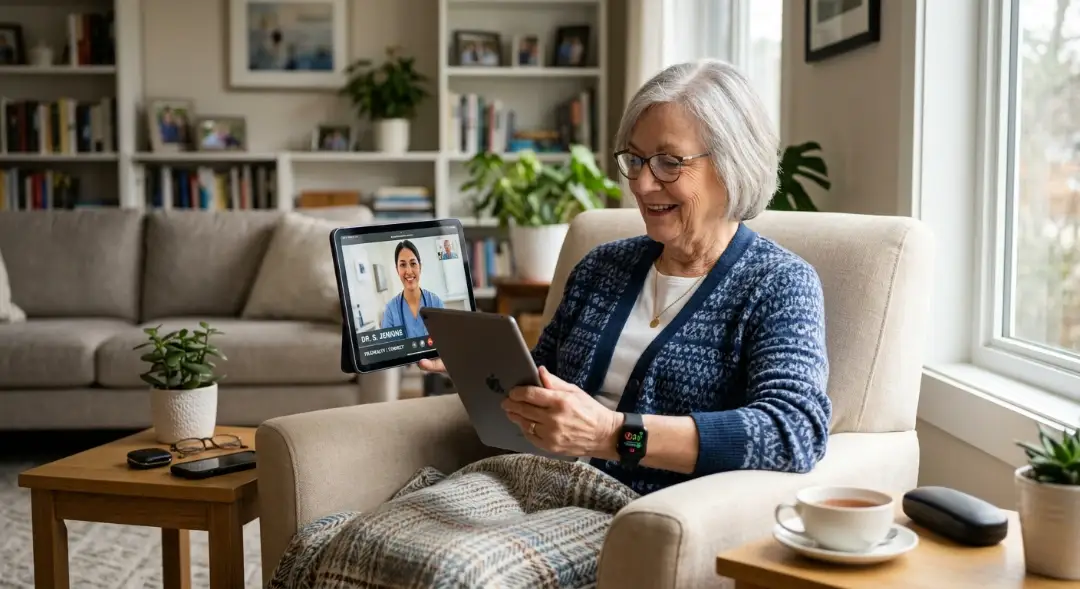
2. Telehealth and Telemedicine
Telehealth lets a patient see a doctor over video instead of driving to an office. For someone with limited mobility, that single change can mean the difference between getting care and skipping it.
Telemedicine visits work well for medication check-ins, follow-up questions, and minor concerns. They don’t replace hands-on exams, but they cut out a lot of unnecessary trips.
3. Wearable Devices with Fall Detection
Wearables have moved past step counting. Many now detect a hard fall and send an alert automatically, even if the person can’t press a button.
For a senior living alone, that single feature can be the reason help arrives in minutes instead of hours. It’s a small piece of hardware doing a job that used to require constant supervision.
4. Smart Medication Dispensers
Missed doses are one of the most common and preventable problems in home care. A smart dispenser locks medication into timed compartments and sends a reminder, or an alert to a family member, if a dose is skipped.
This matters most for people managing several prescriptions at once, where a mix-up can cause real harm.
5. Voice-Activated Home Assistants
Devices like Alexa or Google Home aren’t marketed as medical tools, but they’ve become one in many households. A voice command can turn on lights, call a family member, or set a medication reminder, all without needing to reach for a phone or walk across a room.
For someone with limited mobility or early memory changes, that hands-free control reduces daily risk in small, steady ways.
What Competitors Don’t Tell You: The Caregiver Side of the Story
Most articles on this topic focus entirely on the patient. That leaves out half the picture. Family caregivers are the ones setting up these devices, reading the alerts, and losing sleep over false alarms.
A monitor that sends a 2 a.m. notification for a normal blood pressure blip isn’t helping anyone rest easier. Technology and home care only work well together when the tools are set up correctly for the person, not just installed and left running on default settings.
Before adding any device, ask who’s actually going to manage it day to day. If the answer is an already exhausted family member, look for tools with simple alert settings and a support line you can call when something goes wrong.
Mental Health Technology at Home (A Gap Most Sites Ignore)
Mental health support technology for home care includes simple video portals, digital memory aids, and social engagement platforms designed to reduce isolation in older adults. Loneliness directly impacts physical health, contributing to rapid cognitive decline and higher heart disease risks. Dedicated engagement tablets offer simplified interfaces for video calls with family, interactive brain games, and digital photo frames that update automatically.
Artificial intelligence tools now assist in early cognitive tracking by analyzing speech patterns and response times during routine daily chats. These subtle metrics help families catch early signs of memory loss or depression long before formal clinical tests reflect a change.
Data Privacy: What You Should Know Before Using Home Health Tech
Health information is sensitive, so privacy should be considered before connecting a new device or app.
One common misunderstanding is that every health app automatically falls under HIPAA. That isn’t true. HHS explains that HIPAA applies to covered entities and business associates, and information sent to a consumer app that isn’t a covered entity or business associate may not receive HIPAA protection once it reaches that app.
Before using a device, check:
- What information does it collect?
- Where is the information stored?
- Who can access it?
- Can information be shared with third parties?
- Can the user delete the data?
- Does the device use account security features?
- What happens if the device is lost?
- Does the provider explain its privacy practices clearly?
Use strong passwords and multi-factor authentication when available. Avoid assuming that a familiar brand automatically means your health information receives the same legal protections as information held by a healthcare provider.
Data Comparison: Home Care Tech Investment vs. Value
A basic device may cost less and solve a clear problem. A more advanced system may cost more but offer little benefit if the person cannot use it comfortably.
| Technology | Main purpose | Potential value at home | Key limitation |
|---|---|---|---|
| Telehealth | Remote appointments | Reduces some travel needs | Not suitable for every clinical issue |
| Wearable device | Health or activity tracking | Provides ongoing information | Readings may have limits |
| Remote monitoring | Shares selected health data | Supports ongoing observation | Requires connectivity and follow-up |
| Medication reminder | Supports routines | Helps with scheduled doses | Doesn’t replace medication management |
| Smart home sensor | Safety and activity support | Can provide alerts or automation | Privacy and false alerts matter |
| AI-supported tools | Data analysis | Can identify patterns | Requires appropriate data and oversight |
| Emergency response system | Calls for help | Adds another safety option | Depends on setup and response process |
How to Choose the Right Technology for Your Situation
No single tech setup works for every family. A system that keeps a person with early dementia safe might be completely useless for someone recovering from a major orthopedic surgery. You must match the equipment to the specific health challenges your family faces today.
We recommend starting with a simple needs assessment before buying expensive gear. Sit down and write out the primary safety worries you have during the week. Is the main risk a fall in the bathroom, or is it forgetting to take critical heart medications? Focus your budget entirely on solving those top two vulnerabilities first.
The Future of At-Home Healthcare: What’s Coming Next
Robotics are entering the home care space. Early models can assist with mobility, retrieve objects, and even provide companionship for isolated patients. These aren’t science fiction anymore. Clinical trials are ongoing.
Personalized medicine, driven by genetic testing, is also getting closer to everyday use. Imagine a doctor prescribing medication based on your specific DNA profile, delivered through a service that starts at home. That’s where healthcare accessibility is heading.
Blockchain for health records will make it safer to share your medical history across providers without the risk of data breaches. This means more coordinated, seamless care regardless of which provider you’re working with.
Trusted Home Care Services in Denver
If you’re looking for professional, compassionate support closer to home, Castle Pines Home Care offers personalized home care services in Denver and surrounding areas. Our team works alongside technology-enabled care plans to give clients and families real peace of mind. Whether you need companion care, daily living assistance, or coordination with medical providers, we’re here to help.
Frequently Asked Questions
Is home health technology covered by insurance or Medicare?
Some home health technology is covered by Medicare or private insurance, though coverage varies by device and diagnosis. Telehealth visits are commonly covered, while consumer wearables usually aren’t. Remote patient monitoring is often covered when a doctor orders it as part of a treatment plan, so it’s worth asking your provider directly before assuming a cost.
What’s the easiest home health tech for a senior who isn’t tech-savvy?
A medical alert device with automatic fall detection is usually the easiest starting point. It requires no app, no login, and no daily interaction beyond wearing it. Voice-activated assistants come in second, since spoken commands are simpler than screens or buttons for most first-time users.
Can technology fully replace an in-home caregiver?
No, technology can’t fully replace an in-home caregiver, and it isn’t meant to. Devices track data and send alerts, but they can’t help someone get dressed, prepare a meal, or notice subtle changes in mood the way a person can. The strongest setups combine both.
How do I know if a home health device is legitimate and safe?
A legitimate device will list FDA clearance or certification if it’s making medical claims, and will state its data privacy policy clearly. If a product avoids both of those details, treat that as a red flag rather than an oversight.
How much does home health care technology usually cost per month?
Most individual devices run between $20 and $80 a month, though many are partly covered by insurance or Medicare when a doctor orders them. Costs depend heavily on whether the device is medical grade or consumer grade, so it pays to compare a few options and ask about coverage before buying outright.